
ISO Certification for Hospitality Industry
Saudi Arabia’s hospitality sector is expanding at a pace few industries can match. Vision 2030 has brought an influx of international hotel brands, entertainment destinations, and travel infrastructure, and with that growth comes pressure to meet international service, safety, and environmental standards. iso certification for hospitality industry operations has become a recognised benchmark for hotel groups, food and beverage operators, facility management companies, and tourism businesses seeking to build credibility with guests, corporate clients, and regulators. Finsoul Network KSA supports hospitality businesses across the Kingdom in achieving and maintaining the ISO certifications that align with their service commitments and commercial objectives.
Why ISO Certification Matters for Hospitality Businesses
Hospitality operates on reputation. A single food safety incident, a data breach involving guest records, or a pattern of inconsistent service can spread through online reviews and corporate travel networks faster than most businesses can respond. Structured management systems reduce these risks before they reach guests.
iso certification for hospitality industry businesses provides a recognised framework for embedding quality, food safety, environmental responsibility, and information security into daily operations. It also communicates something specific to corporate travel managers, event planners, and international hotel groups conducting due diligence: that your operation follows documented standards rather than informal habits.
For properties and operators in Saudi Arabia, certification supports positioning in a competitive market where international guests and business travellers increasingly expect the same standards they encounter globally.
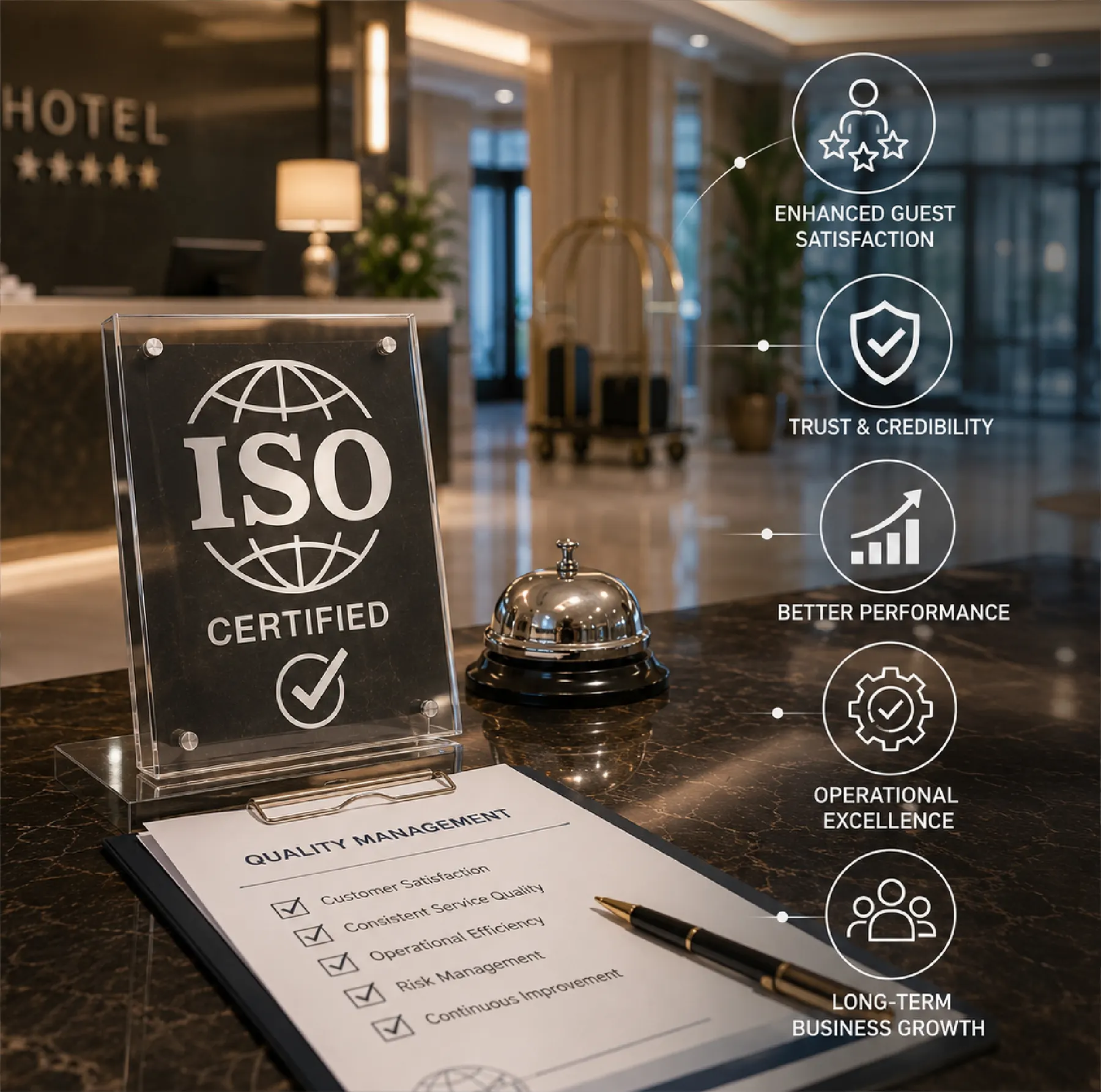
Types of ISO Standards Used in Hospitality Operations
ISO standards for hospitality industry requirements differ depending on the type of service a business provides, the guests it serves, and the regulatory environment it operates within.
ISO 9001 Quality Management System
ISO 9001 quality management hospitality is the most widely adopted ISO standard across hotels, resorts, and hospitality service providers. It establishes requirements for consistent service delivery, documented processes, customer satisfaction measurement, and continual improvement. For hospitality businesses pursuing corporate contracts, management agreements, or franchise approvals in Saudi Arabia, ISO 9001 is frequently a minimum qualification criterion.
ISO 14001 Environmental Management System
ISO 14001 addresses how a business manages its environmental impact across energy use, water consumption, waste disposal, and procurement practices. For large hotel properties and hospitality operators in Saudi Arabia working toward sustainability targets aligned with Vision 2030, ISO 14001 provides the documented framework needed to measure, manage, and demonstrate environmental performance. ISO 14001 internal audit hospitality reviews are an important part of maintaining active compliance with environmental commitments and identifying areas for ongoing improvement.
ISO 27001 Information Security Management System
ISO 27001 for the hospitality sector covers the security of guest data, payment information, booking systems, loyalty program databases, and the technology infrastructure that supports property operations. Hotels collect and process significant volumes of personal and financial data, and enterprise clients increasingly require demonstrated information security governance before signing group accommodation or venue contracts. ISO 27001 certification provides the structured framework for managing these risks.
ISO 45001 Occupational Health and Safety Management
ISO 45001 applies to workplace health and safety across housekeeping, kitchen operations, maintenance, and facilities management. For large resort properties and hospitality operators with significant operational workforces, a certified safety management system supports compliance with Saudi Labour Law requirements and demonstrates duty-of-care governance to staff, insurers, and regulatory bodies.
ISO 22000 Food Safety Management System
ISO 22000 covers food safety management across the full supply chain, from ingredient procurement through preparation, service, and storage. For hotels, restaurants, catering companies, and any hospitality operator running food and beverage facilities in KSA, ISO 22000 gap analysis in KSA is often the first step toward a structured food safety program that meets both international standards and Saudi Food and Drug Authority expectations. Certification reduces the risk of incidents, supports regulatory compliance, and demonstrates food safety governance to guests and institutional clients.
ISO Certification Process for Hospitality Companies
The path from current operations to a certified management system follows a structured sequence regardless of which ISO standard is being pursued.
Start Building Your ISO System Today
From reviews to guidance on audit readiness, we offer ISO Management System Services for hospitality and tourism companies in Saudi Arabia to meet requirements and prepare for certification.
01
Gap Analysis and Initial Assessment
The process begins with a detailed review of your current management practices against the requirements of the target ISO standard. For food safety, this includes an ISO 22000 gap analysis hotel KSA assessment that maps existing controls against the standard’s requirements for hazard analysis, prerequisite programs, and food safety plans. The gap analysis identifies where current practices already meet the standard and where new documentation, procedures, or controls need to be developed.
02
Documentation and System Development
Based on the gap analysis, a management system is built and documented to cover the policies, procedures, and records required by the ISO standard. For hospitality operations, this includes service delivery procedures, food safety plans, environmental management programs, guest complaint processes, and supplier qualification frameworks. Documentation must reflect the specific services and facilities within the certification scope.
03
Implementation and Training
Documented systems need people who understand them. Implementation deploys updated procedures across the relevant teams and provides targeted training to staff whose daily work falls within the certification scope. For hospitality businesses, this covers front office, food and beverage, housekeeping, maintenance, and management functions depending on which standards are being implemented.
04
Internal Audit
Before an external certification body conducts its assessment, an internal audit for hospitality operations tests whether documented procedures are being followed in practice, identifies remaining non-conformances, and produces a corrective action record. ISO 9001 internal audit hospitality and ISO 14001 internal audit hospitality reviews also provide the management evidence that certification bodies look for when assessing whether a system is genuinely active rather than paper-based.
05
External Audit and Certification
An accredited certification body conducts a two-stage external audit. Stage one reviews documentation and confirms readiness. Stage two assesses actual implementation across the operation. Successful completion results in ISO certification, typically valid for three years subject to annual surveillance audits.
Compliance and Risk Management in Hospitality Operations
Hospitality businesses in Saudi Arabia operate within a regulatory environment that covers food safety, data protection, environmental management, and workplace safety simultaneously.

- Food safety controls under ISO 22000 support compliance with Saudi Food and Drug Authority requirements and reduce liability exposure from food safety incidents
- Information security controls under ISO 27001 address guest data protection obligations and reduce the risk of breaches affecting payment and personal data
- Environmental management under ISO 14001 supports alignment with national sustainability requirements and strengthens reporting to ownership groups and investors
- Safety systems under ISO 45001 reduce workplace incidents and support compliance with Saudi Labour Law obligations across operational workforces
- Documented quality processes create audit trails that support franchisor compliance reviews, management agreement audits, and corporate client due diligence
- Structured ISO systems improve readiness for licensing applications, regulatory inspections, and institutional procurement processes
Benefits of ISO Certification for Hospitality Businesses
Structured certification delivers commercial, operational, and reputational advantages for hospitality operators across Saudi Arabia’s growing tourism and business travel market.
Stronger Position in Corporate and Institutional Markets
Corporate travel programmes, government accommodation contracts, and event procurement processes in Saudi Arabia routinely include ISO certification among their supplier qualification criteria. Certified properties and operators qualify for opportunities that non-certified competitors cannot access, with direct consequences for occupancy rates and venue revenue.
Reduced Operational and Regulatory Risk
Certified management systems reduce the likelihood of food safety incidents, guest data breaches, environmental violations, and workplace accidents by embedding structured controls into daily operations rather than relying on informal practice. Each of these risk categories carries direct financial exposure through regulatory penalties, insurance claims, and reputational consequences in a market where online visibility amplifies operational failures.
Credibility with International Partners and Franchisors
Hotel groups operating under international franchise or management agreements frequently face ISO certification requirements from their franchisor or brand partner. Certification demonstrates that local operations meet the same management standards applied across the international network, which supports brand approvals, renewal negotiations, and expansion discussions.
Improved Guest Trust and Service Consistency
Certified quality and food safety systems produce more consistent guest experiences by standardising how services are delivered and how problems are handled. For hospitality operators in Saudi Arabia competing for repeat business from both domestic and international travellers, service consistency is a commercial asset that ISO 9001 and ISO 22000 frameworks directly support.
Documentation and Quality Management System Requirements
Documentation is the operational backbone of any ISO-certified hospitality system, particularly in an environment where regulatory inspections, franchisor audits, and corporate client reviews can occur with limited notice.
- Service delivery procedures define how key guest-facing and operational processes are performed to ensure consistency across shifts, departments, and properties
- Food safety plans and hazard analysis records document how food safety risks are identified and controlled from procurement through service
- ISO 9001 quality management hospitality documentation captures how service quality is monitored, measured, and improved across customer-facing operations
- Guest complaint and feedback records provide evidence of how the business responds to service failures and drives continual improvement
- Supplier qualification files maintain approval and performance records for food suppliers, technology vendors, and facility management contractors
- Management review reports capture leadership decisions on performance data, audit findings, and system improvement priorities
Challenges in ISO Certification for Hospitality Operations
Hospitality operations present a distinct set of certification challenges that differ from other industry sectors.
01
High Staff Turnover and Training Continuity
Hospitality businesses in Saudi Arabia often experience significant staff turnover, particularly in food and beverage, housekeeping, and front office roles. When staff who have been trained on ISO procedures leave, the knowledge transfer gap can erode compliance between audit cycles. Certification programs need to embed procedures into operational documentation rather than relying on individual knowledge.
02
Maintaining Standards Across Multiple Outlets and Shifts
Large hotel properties operate food and beverage outlets, spa facilities, event spaces, and accommodation across multiple departments running continuous shift patterns. Applying consistent ISO procedures across all of these simultaneously requires clear ownership, regular internal audit for hospitality functions, and management systems that work for operational teams rather than adding administrative burden.
03
Seasonal and Demand Variation
Saudi Arabia’s hospitality sector experiences significant demand variation across religious seasons, national holidays, and major events. ISO management systems need to account for how procedures are maintained during peak periods when operational pressure is highest, and the risk of shortcuts is greatest.
04
Aligning ISO Requirements with Franchisor Standards
Many hospitality operators in KSA work within international franchise frameworks that already carry their own quality and safety requirements. Integrating ISO certification with existing brand standards without creating duplicate documentation and conflicting audit processes requires careful scoping and system design from the outset.
ISO Certification Across Hospitality Business Types
iso certification for hospitality industry requirements differ based on the specific type of operation and the services it provides.
Hotels and Resorts
Full-service hotels and resort properties typically pursue ISO 9001 for service quality, ISO 22000 for food and beverage operations, and ISO 14001 for environmental management. Large properties with significant workforces add ISO 45001 to cover health and safety governance. International brand properties may also require iso 27001 for the hospitality sector to cover guest data and technology systems.
Food and Beverage Operators and Catering Companies
Standalone restaurant groups, contract catering operators, and event catering businesses prioritise ISO 22000 as their primary certification. ISO 22000 gap analysis hotel KSA processes are equally applicable to catering companies supplying hotels, corporate facilities, and institutions across the Kingdom.
Paste text
Facility Management and Support Services
Facility management companies providing housekeeping, maintenance, and operational support to hotels and hospitality properties typically pursue ISO 9001 and ISO 45001 to meet contractor qualification requirements from their hotel clients.
Tourism and Destination Operators
Tourism businesses, destination management companies, and leisure operators in Saudi Arabia increasingly face ISO certification requirements from corporate clients and international travel companies. ISO 9001 provides the quality management framework that underpins professional service delivery in this segment.
Why Choose Finsoul Network KSA for ISO Certification Support
Finsoul Network KSA brings structured, sector-relevant knowledge to iso certification for hospitality business requirements across Saudi Arabia’s growing tourism and travel market.
Deep familiarity with the operational, regulatory, and commercial environment facing hospitality businesses in KSA, enabling guidance that reflects real service delivery conditions rather than generic compliance frameworks
End-to-end certification support covering gap analysis, ISO 22000 gap analysis hotel KSA assessments, documentation development, internal audit for hospitality preparation, and external audit coordination with accredited certification bodies
Specialist knowledge of ISO 9001 internal audit hospitality and ISO 14001 internal audit hospitality requirements in a Saudi regulatory context where environmental and food safety obligations continue to evolve
Integration of ISO documentation with ZATCA compliance records, Saudi Food and Drug Authority requirements, and franchisor or brand audit frameworks to reduce total compliance cost and avoid duplication
Scalable support models that work for independent hotel operators and large multi-property groups alike, without requiring large internal compliance teams to manage the certification programme
Ongoing surveillance support after certification to maintain compliance through annual audits and management system updates as operations grow and regulations develop
Note: The above-mentioned services are provided via network firms if not provided directly.
Our Clients' Stories
The Challenge
A Jeddah-based hotel group operating two full-service properties and a standalone restaurant outlet had reached the point where a major corporate travel management company was requiring ISO 9001 and ISO 22000 certification as conditions for inclusion in their preferred accommodation programme. The group had informal service delivery practices and existing food safety routines, but no documented management systems, no internal audit process, and no formal supplier qualification framework. The travel company had set a five-month deadline before the contract decision would be made.
Our Approach
Finsoul Network KSA conducted simultaneous gap analyses across ISO 9001 and ISO 22000 requirements covering both hotel properties and the restaurant outlet. The certification scope was defined to include core service delivery, food and beverage operations, and key supplier relationships. Service delivery procedures and food safety plans were developed with input from department heads, a hazard analysis was completed for all food handling areas, and supplier qualification records were established across food and cleaning product vendors. Staff training covered food safety responsibilities, service quality procedures, and complaint handling across all properties within scope. An internal audit for hospitality was completed six weeks before the planned external audit, with all identified non-conformances resolved and documented before the certification body visit.
Outcome
The hotel group achieved dual ISO 9001 and ISO 22000 certification within the required timeline and was included in the corporate travel programme ahead of the contract decision. The structured food safety system identified two temperature monitoring gaps in cold storage that had not been previously documented, which were corrected before any guest impact occurred. The business has maintained both certifications through one full surveillance cycle without any major findings, and has since used the certified management systems to qualify for two additional corporate procurement processes.
Begin Your ISO Certification Journey With ISO Consultants KSA
Hospitality businesses in Saudi Arabia that pursue structured ISO certification gain a measurable advantage in corporate contract access, regulatory compliance, and operational risk management. Finsoul Network KSA provides the specialist guidance and practical support needed to achieve iso certification for hospitality industry standards on time and within budget.
FAQs
What ISO certifications are most important for hospitality businesses in Saudi Arabia?
ISO 9001 and ISO 22000 are the most widely required certifications for hotel and food and beverage operators in KSA. ISO 14001 is increasingly relevant for properties with sustainability commitments, and ISO 27001 is required by corporate clients with strict data security requirements.
How long does it take to achieve ISO certification for a hospitality business?
Most hospitality businesses complete certification in three to six months depending on the number of outlets in scope, the standards being pursued, and the maturity of existing procedures at the start of the process.
What does ISO 22000 cover for hotels and food operators?
ISO 22000 covers how a business identifies and controls food safety risks across procurement, storage, preparation, and service. It includes hazard analysis, prerequisite programs, and documented food safety plans that meet both international standards and Saudi Food and Drug Authority requirements.
Is ISO 9001 required for corporate hotel contracts in KSA?
Many corporate travel programmes and government accommodation contracts in Saudi Arabia include ISO 9001 among their supplier qualification criteria. Certified properties qualify for procurement processes that are closed to non-certified operators.
How does ISO certification support hospitality businesses during regulatory inspections?
Certified management systems maintain documented records across food safety, environmental controls, and service procedures. These records provide clear evidence of compliance governance during Saudi Food and Drug Authority inspections, municipality audits, and franchisor compliance reviews.