
ISO Certification for Healthcare Industry
Saudi Arabia’s healthcare sector operates under tightening regulatory pressure from the Saudi Food and Drug Authority, the Ministry of Health, and accreditation frameworks tied to Vision 2030’s national health transformation targets. Healthcare organizations need management systems that demonstrate patient safety governance, service quality discipline, and operational resilience to patients, payors, and regulators alike. ISO certification for the healthcare industry has become a standard requirement for securing institutional contracts, maintaining licensing credibility, and meeting the quality expectations of both domestic and international healthcare stakeholders. Finsoul Network KSA supports healthcare organizations across the Kingdom in achieving and maintaining the ISO certifications that matter most to their operations, their patients, and their regulators.
Why ISO Certification Matters for Healthcare Providers
Healthcare providers handle sensitive patient data, clinical processes, and life-affecting services where a failure in quality, security, or continuity carries consequences that extend well beyond operational disruption. A breach in patient data, a gap in service quality, or a breakdown in business continuity can trigger regulatory action, contract loss, and reputational damage that affects patient trust for years.
ISO certification for healthcare providers offers a structured framework that reduces these risks by embedding consistent controls across quality, information security, and risk management functions. Certification also communicates to procurement committees, insurance networks, and government health authorities that an organization meets internationally recognized standards, a factor that directly influences contracting and partnership decisions in Saudi Arabia’s expanding private healthcare market.
Organizations that pursue Healthcare ISO compliance gain measurable advantages in institutional contract access, build credibility with SFDA and MOH oversight functions, and develop internal governance structures that improve long-term clinical and operational performance.
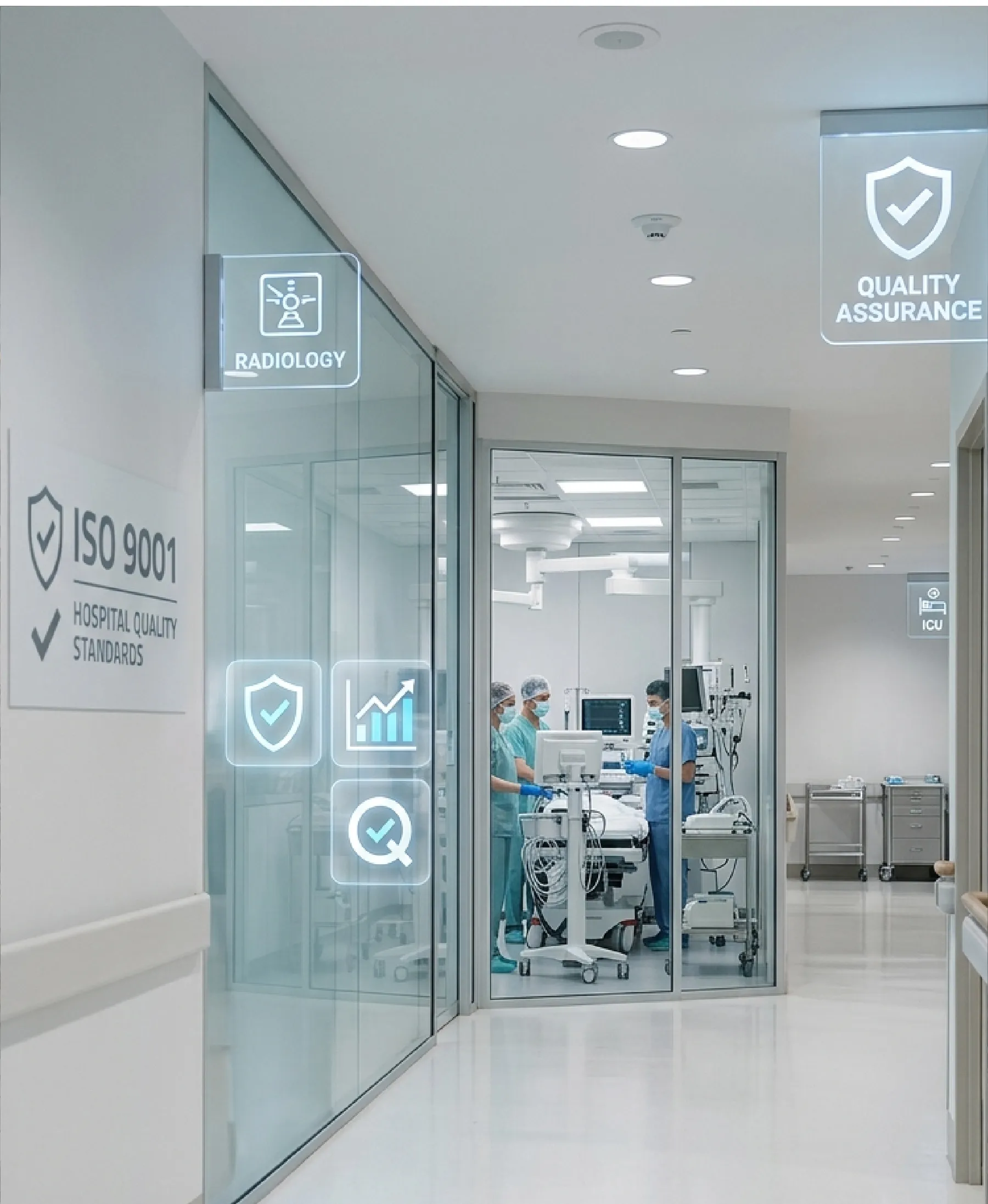
Types of ISO Standards Used in Healthcare Operations
Different operational areas within healthcare require different ISO standards. Understanding which certifications apply to your organization is the first step toward building a compliant and commercially effective management system.
ISO 9001 for Healthcare
Healthcare ISO 9001 certification applies the internationally recognized quality management framework to clinical service delivery, patient operations, and administrative processes. It establishes requirements for process documentation, service consistency, customer focus, and continual improvement. For hospitals, clinics, diagnostic laboratories, and medical device suppliers operating in Saudi Arabia, healthcare quality management systems built on ISO 9001 provide the structural discipline that institutional clients and government payors expect before entering long-term agreements.
ISO 27001 Information Security Management
ISO 27001 establishes requirements for identifying information assets, assessing security risks, implementing controls, and maintaining ongoing security governance across the organization. For healthcare providers processing electronic patient records, clinical data systems, and telemedicine platforms, ISO 27001 certification is increasingly a condition of enterprise partnerships and health authority data handling expectations under Saudi Arabia’s Personal Data Protection Law.
ISO 22301 for Healthcare
ISO 22301 for healthcare establishes the requirements for a Business Continuity Management System. Healthcare organizations face risks that other sectors do not; power failures, supply chain disruptions, and mass casualty events can all interrupt services at exactly the moments patients most depend on them. Business continuity for healthcare under ISO 22301 ensures that critical clinical functions have documented recovery plans, tested continuity procedures, and the organizational capacity to maintain patient safety through disruption. For hospitals and integrated care providers in Saudi Arabia, this standard carries increasing weight as MOH accreditation frameworks give greater attention to operational resilience.
ISO 31000 Risk Management
ISO 31000 provides a framework for identifying, assessing, and managing risks across healthcare operations. Unlike clinical-specific risk tools, ISO 31000 applies across strategic, operational, financial, and patient safety risk areas. It is particularly relevant for healthcare organizations in Saudi Arabia, where risk governance is a standing expectation of MOH accreditation assessments and institutional partnership processes.
ISO 13485 Medical Devices Quality Management
ISO 13485 applies specifically to organizations involved in the design, manufacture, supply, or servicing of medical devices. SFDA registration processes for medical device suppliers in Saudi Arabia align closely with ISO 13485 requirements, making this certification a practical prerequisite for suppliers entering or expanding within the Kingdom’s medical technology market.
ISO Certification Process for Healthcare Organizations
The path from current operations to a certified management system requires honest assessment, structured planning, and disciplined execution across several sequential stages.
Start Building Your ISO System Today
From reviews to guidance on audit readiness, we offer ISO Management System Services for healthcare and medical companies in Saudi Arabia to meet requirements and prepare for certification.
01
Gap Analysis and Initial Assessment
The process begins with a detailed review of current management systems against the requirements of the target ISO standard. Experienced ISO certification consultants for healthcare assess existing controls, map gaps, and build a realistic implementation plan aligned to the certification timeline. For ISO 9001, this means evaluating current quality processes against the standard’s requirements across clinical, administrative, and supplier management functions. The gap analysis identifies where current practices already meet the standard and where new procedures, documentation, or controls need to be developed.
02
Documentation and System Development
Based on the gap analysis, a management system is built and documented. For healthcare quality management systems, this includes a Quality Policy, documented process maps for core service workflows, patient complaint handling procedures, and supplier qualification frameworks. Hospital ISO certification industry documentation must also reflect applicable SFDA and MOH requirements to avoid creating parallel compliance gaps.
03
Implementation and Training
Documented systems only work if the people responsible for running them understand their roles. Implementation involves deploying updated policies and procedures across relevant clinical and administrative teams and providing targeted training to staff whose daily work falls within the certification scope. For healthcare organizations, this typically covers clinical operations, patient administration, facilities, and supply chain functions.
04
Internal Audits for Healthcare
Before the external certification audit, internal audits for healthcare Clinical internal audits test whether procedures are being followed across the certified scope, identify remaining gaps, and produce a corrective action record. A clean internal audit gives the certification body confidence that the management system is functioning as documented, not just written. Internal audit capability is also a long-term operational asset; organizations that conduct structured internal audits consistently perform better at surveillance reviews and recertification.
05
External Audit and Certification
An accredited certification body conducts a two-stage external audit. Stage one reviews documentation and confirms readiness. Stage two assesses actual implementation across the organization. Successful completion results in ISO certification, typically valid for three years, subject to annual surveillance audits.
Compliance and Risk Management in Healthcare Operations
Healthcare organizations in Saudi Arabia need structured systems to manage regulatory, clinical, and operational risks across services where failure has direct patient safety implications.

- Quality process controls under ISO 9001 support compliance with MOH service delivery standards and reduce exposure to patient complaint escalation and regulatory review
- Information security controls under ISO 27001 address SFDA and PDPL obligations around electronic health records and patient data handling
- Business continuity for healthcare under ISO 22301 provides documented recovery procedures that protect patient care continuity through operational disruptions
- Risk governance frameworks under ISO 31000 give leadership systematic visibility into strategic, operational, and clinical risk exposure
- Structured ISO documentation improves readiness for MOH accreditation assessments, SFDA audits, and institutional procurement due diligence
- Management system discipline reduces variability in patient-facing service delivery and builds the audit trail that regulatory bodies and insurance networks require
Benefits of ISO Certification for Healthcare Providers
Pursuing ISO certification delivers measurable clinical, commercial, regulatory, and operational advantages for healthcare organizations in Saudi Arabia’s expanding health sector.
Institutional Contract Access
ISO certification for healthcare providers is a stated requirement in procurement processes run by insurance networks, government health authorities, and large corporate healthcare groups across Saudi Arabia. Certified organizations qualify for contract opportunities that are closed to non-certified competitors, which directly affects patient volume and revenue in a market where institutional relationships define commercial scale.
Regulatory Credibility
ISO consultants for healthcare work with organizations operating under MOH and SFDA oversight, where demonstrated quality and risk governance influence both licensing relationships and accreditation outcomes. ISO-certified management systems show regulators that an organization has embedded controls rather than applying compliance reactively.
Reduced Clinical and Operational Risk
Certified quality and safety systems reduce the likelihood of service failures, patient data breaches, and compliance gaps by building structured controls into daily operations. For healthcare providers, where a single quality failure can trigger regulatory investigation and reputational damage, this risk reduction carries direct operational value.
Investor and Partnership Confidence
ISO certification for the healthcare industry communicates governance maturity to investors, joint venture partners, and international healthcare groups entering Saudi Arabia’s growing private health market. For organizations pursuing expansion funding or regional partnership agreements, certification removes a common due diligence concern before it becomes an obstacle.
Documentation and Quality Management System Requirements
Documentation is the operational backbone of any ISO-certified healthcare system, particularly in an environment where MOH inspections and accreditation assessments can occur with limited notice.
- Quality Policy and Scope Statement define the organizational commitment and boundaries that underpin ISO 9001 certification
- Process maps and standard operating procedures capture how clinical and administrative services are delivered, monitored, and improved
- Risk registers and treatment plans document how identified threats are assessed and managed across clinical and operational functions
- Patient complaint handling and service recovery procedures establish consistent responses to quality failures across the organization
- Internal audit schedules and corrective action records demonstrate ongoing management system performance between surveillance audits
- Supplier and third-party qualification records maintain audit evidence of vendor approval, review, and compliance status
- Management review records capture leadership decisions on performance data, audit findings, and improvement priorities
Challenges in ISO Certification for Healthcare Organizations
Achieving and sustaining ISO certification in a complex healthcare environment involves a distinct set of practical challenges.
01
Defining Scope Across Complex Care Settings
Healthcare organizations often deliver services across multiple sites, specialties, and care settings. Defining a clear and defensible ISO certification scope that covers the services clients and regulators care about without becoming unmanageable requires experienced judgment. Too broad, and documentation becomes a compliance burden. Too narrow, and certification fails to address the areas that matter most to payors and accreditation bodies.
02
Balancing Clinical Operations with Documentation Requirements
Healthcare teams are rightly focused on patient care, not documentation processes. ISO certification requires formal record-keeping, change management, and structured review cycles that can feel at odds with the pace of clinical work. Organizations that integrate documentation requirements into existing clinical workflows rather than treating them as a separate compliance layer typically achieve better results and sustain certification more effectively.
03
Managing Supplier and Third-Party Risk
Healthcare operations rely on medical equipment suppliers, IT infrastructure providers, outsourced laboratory services, and facility management contractors whose quality and security posture directly affects patient outcomes and regulatory compliance. ISO standards require that third-party risks are assessed and managed formally, which means supplier qualification reviews, contractual quality requirements, and ongoing performance monitoring need to be built into procurement processes.
04
Sustaining Compliance After Certification
ISO certification for healthcare industry is not a one-time achievement. Annual surveillance audits and a three-year recertification cycle require ongoing documentation management, internal audit execution, and management review discipline. Organizations that treat certification as a project rather than an operational function typically find their systems degrading between audit cycles.
05
Staff Turnover and Knowledge Continuity
Healthcare organizations face consistent staff movement across clinical and administrative roles. When key personnel who built the management system leave, institutional knowledge of why specific controls exist and how procedures connect to the ISO standard can be lost. Effective certification programs embed that knowledge into documentation and training records, not in people’s heads alone.
ISO Certification Across Healthcare Organization Types
ISO certification for healthcare requirements differs based on the type of organization, the services provided, and the patient populations served.
Hospitals and Integrated Health Systems
Hospitals pursuing ISO 9001 certification typically scope the program across clinical service lines, patient administration, and support services. ISO 22301 for healthcare is particularly relevant for hospitals, where service continuity during infrastructure failures or mass casualty events directly affects patient safety outcomes. Many hospital certification programs combine ISO 9001 and ISO 22301 to satisfy both quality and resilience requirements in a single integrated program.
Diagnostic Laboratories and Imaging Centers
Diagnostic facilities handle sensitive patient specimens and data under strict quality and handling requirements. ISO 9001 provides the quality framework for specimen management, result reporting, and equipment calibration. ISO 27001 addresses patient data security in environments where electronic result delivery and third-party system integrations create information security exposure.
Primary and Specialist Clinics
Outpatient clinics and specialist practices pursuing institutional contracts with insurance networks or corporate health programs frequently require ISO certification for healthcare providers as a qualification condition. ISO 9001 is the standard entry point, with scope typically covering patient registration, clinical consultation, referral management, and patient complaint handling.
Medical Device Suppliers and Distributors
Organizations supplying or distributing medical devices in Saudi Arabia face SFDA registration requirements that align with ISO 13485. ISO certification consultants for healthcare with medical device experience help suppliers navigate the intersection of ISO 13485 requirements and SFDA technical file expectations, reducing registration delays and compliance gaps.
Healthcare IT and Digital Health Providers
Digital health companies providing electronic health records, telemedicine platforms, or clinical decision support tools face information security expectations from both healthcare institution clients and PDPL obligations. ISO 27001 certification addresses these requirements and is often a condition of integration approval with major Saudi healthcare networks.
Why Choose Finsoul Network KSA for Healthcare ISO Certification
ISO consultants for healthcare at Finsoul Network KSA bring structured, sector-specific knowledge to ISO certification for healthcare industry requirements across Saudi Arabia’s regulated health market.
Deep familiarity with MOH accreditation expectations, SFDA regulatory requirements, and the practical quality and security standards facing healthcare organizations in KSA, enabling guidance that reflects real operating conditions
End-to-end support from experienced ISO certification consultants for healthcare covering gap analysis, documentation development, internal audits for healthcare preparation, and external audit coordination with accredited certification bodies
Integration of ISO documentation with MOH examination readiness, SFDA compliance records, and institutional due diligence requirements to reduce total compliance cost and avoid duplicated effort
Specialist knowledge of ISO 9001 for healthcare, ISO 22301 for healthcare, and ISO 27001 requirements in a KSA regulatory environment where quality and safety standards continue to evolve alongside Vision 2030 health transformation targets
Scalable support models that work for single-site clinics and multi-facility health systems, without requiring large internal compliance teams to manage the certification program
Proven capability to coordinate certification across clinical, administrative, and technology functions where responsibilities are distributed across teams managing multiple regulatory requirements simultaneously
Ongoing surveillance support after certification to maintain compliance through annual audits and management system updates as services, infrastructure, and regulations evolve
Note: The above-mentioned services are provided via network firms if not provided directly.
Our Clients' Stories
The Challenge
A mid-sized specialist clinic group operating across two locations in Jeddah needed ISO certification for healthcare providers to qualify for a preferred provider agreement with a major national health insurance network. The group had strong clinical outcomes but inconsistent administrative documentation across its registration, referral, and billing functions. Process ownership was unclear between site managers, and there was no management review process in place. The insurer’s qualification deadline gave the team four months.
Our Approach
Finsoul Network KSA conducted a gap analysis focused on ISO 9001 for healthcare requirements across both clinic sites, covering patient registration, referral coordination, complaint handling, and supplier management. Standard operating procedures were developed for each core administrative workflow, and process ownership was clarified between site managers and the group’s operations function. A management review schedule was established and executed within the timeline. The scope was defined to cover the services directly relevant to the insurance network qualification, keeping the program achievable within four months.
Outcome
The clinic group achieved ISO 9001 certification ahead of the insurer’s deadline and successfully qualified for the preferred provider agreement. The structured documentation also reduced confusion between sites on patient referral handling, improving response times and reducing administrative errors. The management system continues to function as an active operational tool rather than a compliance file.
Begin Your ISO Certification Journey
Healthcare organizations in Saudi Arabia that pursue structured ISO certification gain a measurable advantage in institutional contract access, regulatory credibility, and clinical risk management. Finsoul Network KSA provides the specialist guidance and practical support needed to achieve ISO certification for healthcare industry requirements on time and within budget.
FAQs
What ISO certifications are most important for healthcare organizations in Saudi Arabia?
Healthcare ISO 9001 certification is the primary certification for quality management, widely required for MOH accreditation and insurance network qualification. Healthcare ISO 22301 certification addresses business continuity, and ISO 27001 covers patient data security. The right combination depends on the organization’s services and client requirements.
How long does it take to achieve ISO certification for healthcare industry requirements?
Most healthcare organizations complete the process in three to six months, depending on organizational size, the number of standards being pursued, and the maturity of existing quality and safety practices at the start of the engagement.
Is ISO certification for the healthcare industry recognized by the Saudi MOH and SFDA?
ISO certification is recognized in both MOH accreditation frameworks and SFDA quality expectations. While it does not automatically replace sector-specific licensing requirements, certified management systems strengthen regulatory relationships and support licensing and accreditation outcomes.
What does ISO 22301 for healthcare specifically cover?
ISO 22301 for hospitals covers business continuity planning, including risk identification, recovery time objectives, tested continuity procedures, and governance structures that maintain critical clinical functions during disruptions such as infrastructure failures or supply chain interruptions.
How do internal audits for healthcare fit into the ISO certification process?
Healthcare audit services are a required element of every ISO management system, conducted before the external audit to confirm procedures are being followed, close remaining gaps, and demonstrate to the certification body that the organization actively monitors its own compliance throughout the three-year cycle.