
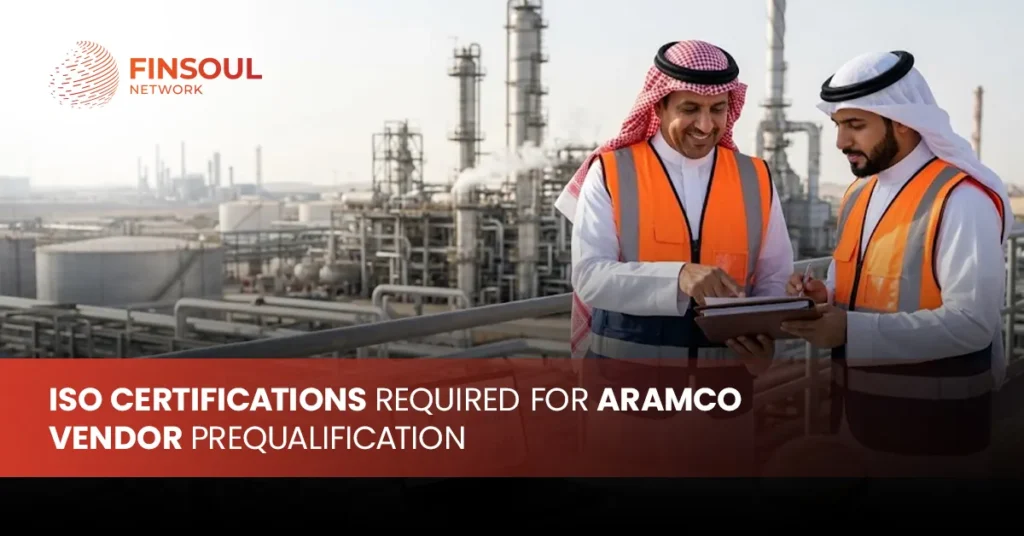
Getting on Saudi Aramco’s approved supplier list opens the door to some of the largest contracts in the Kingdom, but the path there runs directly through Aramco vendor registration and a specific set of ISO certifications. At Finsoul Network KSA, we work with suppliers across Saudi Arabia who want to understand exactly what ISO certification Saudi Arabia authorities and Aramco expect before an application is approved. This guide breaks down every stage of the process, the documents involved, and the certifications you need in hand before you submit.
What Is Aramco Vendor Registration
Aramco vendor registration is the formal process through which a company applies to join Saudi Aramco’s approved supplier list. It involves creating a supplier profile, submitting legal and financial documents, and passing a technical and quality review before you can receive requests for quotation on Aramco projects. Without completing the supplier approval process, a business cannot legally supply goods or services to Aramco or its affiliates.
The process is deliberately rigorous. Aramco evaluates applicants on financial stability, technical capability, health and safety compliance, and local content contribution under the IKTVA program. Companies that treat this step as a simple form-filling exercise are usually the ones that get rejected on their first attempt.
Why ISO Certification Saudi Arabia Requirements Matter for Prequalification
ISO certification Saudi Arabia standards sit at the center of Aramco’s prequalification criteria. Before Aramco will consider a supplier for its approved vendor list, it needs proof that the company operates under a recognized quality management system, not just a promise of good service.
This matters because Aramco cannot personally audit every supplier’s internal operations before awarding a contract. Independent certification bodies issue verified proof that a company’s processes meet international benchmarks for quality, safety, and environmental management. For most commodity and service categories, holding the right ISO certificates is what separates an application that moves forward from one that stalls at the first review.
The Aramco Vendor Registration Process Step by Step
The Aramco supplier onboarding process generally follows four stages: prequalification, technical evaluation, field audits, and compliance checks. Each stage builds on the last, so missing documentation early on can delay everything that follows.
- Prequalification: You demonstrate sector experience, submit reference projects, and confirm your commercial registration and licensing are in order.
- Technical Evaluation: Aramco reviews your product or service capability, quality documentation, and relevant ISO certificates against the commodity category you applied under.
- Field Audit: For many categories, Aramco inspects your facility or operations to confirm your quality and safety systems match what was submitted on paper.
- Compliance Check: Aramco verifies financial stability, insurance coverage, and regulatory standing before final approval and listing.
Aramco Vendor Registration Form and Required Documents
Every applicant must complete an Aramco vendor registration form through the supplier portal, along with a set of supporting documents. Missing or mismatched information on the supplier registration application is one of the most common reasons submissions are rejected outright.
| Document | Purpose |
| Commercial Registration certificate | Confirms legal entity status in Saudi Arabia |
| ISO 9001, 14001, 45001 certificates | Proves quality, environmental, and safety management systems |
| Audited financial statements | Demonstrates financial stability |
| Company profile and organization chart | Shows operational structure and capability |
| GOSI and ZATCA certificates | Confirms Saudization and tax compliance |
Every entry on this form must match your official commercial registration exactly, since even a small naming discrepancy can trigger an automatic rejection.
Saudi Aramco Vendor Registration Eligibility Criteria
Not every company qualifies to become an approved Saudi Aramco supplier on its first attempt. Eligibility depends on holding a valid commercial registration, maintaining no outstanding legal disputes with Aramco or its affiliates, and staying current on Saudi tax and labor obligations.
Foreign companies pursuing supplier registration with Saudi Aramco also need a valid MISA investment license before they can proceed. Local content performance under IKTVA is increasingly weighted in eligibility decisions, so companies with a stronger Saudi workforce and procurement footprint tend to receive faster approval.
Aramco Vendor Registration Online Through SAP Ariba
Aramco vendor registration online takes place through the SAP Ariba supplier portal, which is the official platform Aramco uses for supplier onboarding, RFQs, and procurement communication. Setting up a standard supplier account is free, though higher-tier memberships carry annual fees for expanded functionality.
Completing the online supplier registration process involves creating a supplier profile, uploading your documentation, and selecting the correct commodity category code for your business. Choosing the wrong category is a frequent and costly mistake, since your documentation must precisely match the category under which you are evaluated.
Key ISO Certifications You Need
Aramco does not treat certifications as interchangeable paperwork. Reviewers check issue dates, accreditation bodies, and the scope of coverage listed on each certificate against the commodity category you applied under. A certificate that covers manufacturing but not the specific service line you offer can trigger a request for additional evidence, even if your company is technically compliant. Building certification scope around your actual business activity from the start avoids this back-and-forth.
ISO 9001: Quality Management
This is the baseline expectation across almost every Aramco vendor category. It demonstrates that your company has a documented, repeatable quality management system.
ISO 14001: Environmental Management
Required for categories with environmental impact, this certification shows your business manages waste, emissions, and resource use responsibly.
ISO 45001: Occupational Health and Safety
Given Aramco’s strict HSE standards, this certification confirms your company has formal systems for identifying and controlling workplace safety risks.
IKTVA and Local Content Requirements
Aramco’s In-Kingdom Total Value Add program measures how much of a supplier’s activity contributes to the Saudi economy, including Saudi employment, local procurement, and domestic manufacturing. A strong IKTVA score does not replace ISO certification, but it does strengthen an application and can improve contract award probability once a vendor is listed.
Suppliers often underestimate how closely IKTVA and quality certification are linked in practice. A company investing in Saudi manufacturing capacity or hiring locally still needs the underlying quality and safety systems to pass technical review. Treating IKTVA scoring and certification readiness as two separate projects instead of one coordinated effort is a common reason companies with strong local content still face delays.
Common Mistakes That Delay Approval
Most rejected applications fail for avoidable reasons rather than genuine capability gaps. Common issues include:
- Expired or incomplete ISO certificates submitted with the application
- Company details that don’t match the commercial registration exactly
- Selecting the wrong commodity category code
- Missing GOSI, ZATCA, or MISA documentation
- Underestimating how long field audits and technical review actually take
How ISO Consultancy Support Speeds Up Approval
Preparing for this stage is easier with the right ISO consultancy support behind you. Our team helps businesses close certification gaps, prepare documentation, and align their quality management systems with Aramco’s exact evaluation criteria before submission.
Our ISO consultancy team works through gap assessments, implementation support, and documentation review so applicants avoid the delays that come from incomplete or mismatched submissions. Rather than treating certification as a checkbox, this approach builds systems that hold up under Aramco’s field audits and long-term compliance checks.
Final Thoughts
This process is not a one-time form submission. It is a structured evaluation that tests your legal standing, financial health, and quality systems against some of the strictest procurement standards in the region. Holding the right ISO certifications before you apply is the single biggest factor in how smoothly your Aramco vendor registration moves through review.
Finsoul Network KSA works with suppliers across the Kingdom to prepare for every stage of this process, from ISO certification gap assessments to final document submission. If your business is ready to pursue vendor registration with Aramco, getting your quality management systems in order now will save months of back-and-forth later.
Frequently Asked Questions
How Long Does Aramco Vendor Registration Take?
Most applications take three to six months, depending on category complexity, document readiness, and how quickly field audits can be scheduled.
Which ISO Certifications Are Mandatory for Aramco Suppliers?
ISO 9001 is the baseline requirement, with ISO 14001 and ISO 45001 required for most technical, industrial, and HSE-relevant categories.
Can Foreign Companies Complete Aramco Vendor Registration?
Yes, but they need a valid MISA investment license and a registered Saudi legal entity before applying through the supplier portal.
Is Aramco Vendor Registration Free?
The standard SAP Ariba supplier account is free, though document preparation, ISO certification, and translation costs apply separately.
What Causes Most Aramco Vendor Applications to Fail?
Incomplete documentation, mismatched company details, expired certificates, and incorrect commodity category selection cause the majority of rejections.