
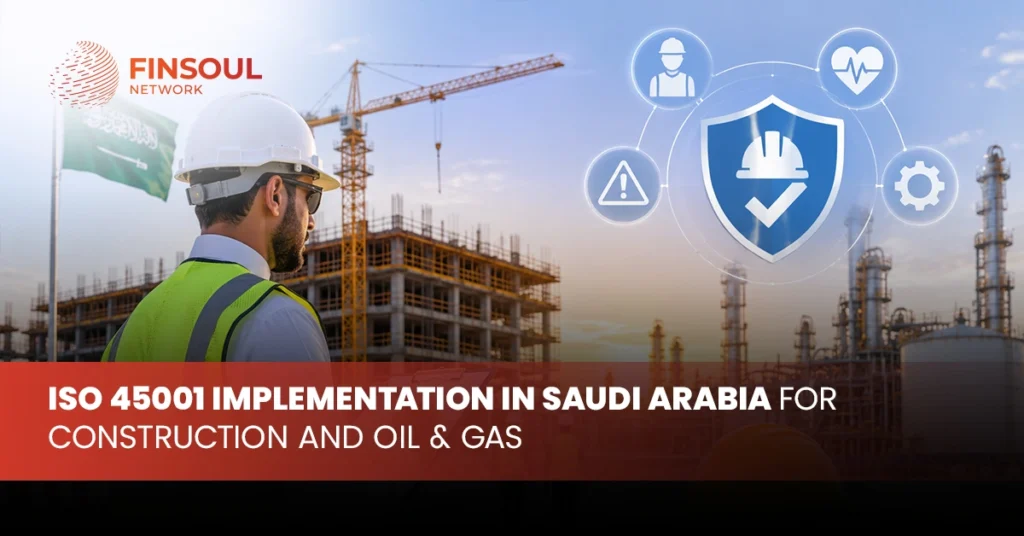
A crane lift goes wrong. A gas line is opened without isolation. A night shift works at height with no rescue plan. Incidents like these rarely come from one bad decision. They grow from weak systems, and weak systems are exactly what an occupational health and safety standard is designed to fix.
Across the Kingdom, giant projects in building, infrastructure, refining and drilling are raising the bar for contractor safety. This article from Finsoul Network KSA explains how ISO 45001 for oil and gas companies and construction firms works in practice, using the Plan-Do-Check-Act cycle as a roadmap. You will also find a hazard comparison table, common pitfalls, and five frequently asked questions.
Why ISO 45001 implementation in Saudi Arabia matters now
ISO 45001 is the international standard for occupational health and safety management systems. It replaced OHSAS 18001 and asks organisations to prevent work-related injury and ill health, not just react to them.
For ISO 45001 implementation in Saudi Arabia, the drivers are practical. Large clients increasingly expect contractors to prove their safety systems before awarding work. Insurers, lenders and project owners all read safety performance as a signal of reliability. A certified system also helps you meet national labour and safety expectations in a consistent, documented way.
Three myths that delay progress
Myth: it is paperwork only. Reality: the standard is about leadership, worker participation and controlling real hazards on site.
Myth: only large companies need it. Reality: subcontractors in the supply chain are often asked for it first.
Myth: certification equals safety. Reality: the certificate opens doors, but daily behaviour on site keeps people alive.
Plan: understand the ISO 45001 requirements KSA organisations must meet
Planning is where most of the value is created. Start by mapping your context: who your interested parties are, what laws apply, and which activities carry the highest risk.
The core ISO 45001 requirements KSA employers should prepare for include:
- A written OH&S policy signed by top management
- Clear roles, responsibilities and authorities
- Hazard identification and risk assessment methods
- A register of legal and other requirements
- Measurable OH&S objectives with action plans
- Processes for worker consultation and participation
Top management involvement is not optional, and it matters even more for ISO 45001 for oil and gas companies, where one leadership decision can affect an entire facility. Auditors look for evidence that leaders allocate budget, attend safety reviews, and respond to worker feedback.
Do: put controls into daily work
Doing means turning plans into site routines. Apply the hierarchy of controls: eliminate the hazard first, then substitute, engineer it out, use administrative controls, and rely on personal protective equipment last.
Typical operational controls include:
- Permit-to-work systems for hot work, confined spaces, and electrical isolation
- Lifting plans and competent rigger supervision
- Contractor induction and prequalification
- Emergency response drills tied to real site layouts
- Management of change before any process or equipment modification
Worker participation is the other half of doing. Give crews a simple way to report hazards, protect them from blame when they do, and show them what changed as a result. People stop reporting when nothing happens, and silence is the most dangerous signal on any site.
Training must match the task. A short toolbox talk is useful, but critical roles need verified competence, with records to prove it.
Why ISO 45001 for oil and gas companies is a different challenge
Hydrocarbon facilities add process safety risks that general construction does not face: flammable atmospheres, high pressure, toxic gases and complex shutdown activities. Because of this, ISO 45001 for oil and gas companies must connect occupational safety with process safety, asset integrity and strict contractor control.
Client rules often go beyond the standard. Operators may demand specific incident reporting formats, safety observation programs and supervisor competency levels. Build these into your system once instead of maintaining separate versions for each client.
Construction versus oil and gas: where the risks differ
| Area | Construction | Oil and gas |
| Top hazards | Falls, lifting, excavation, struck-by | Fire, explosion, gas release, confined space |
| Key control | Work-at-height and lifting plans | Permit-to-work and isolation |
| Workforce | Many subcontractors, changing crews | Specialist contractors, shutdown peaks |
| Emergency focus | Rescue from height, site evacuation | Fire response, muster, spill control |
| Typical evidence | Inspections, method statements | Permits, integrity records, drills |
Use a table like this in your risk workshop. It shows teams where one shared system works and where sector-specific procedures are needed.
Check: measure what actually happens
Checking proves whether controls work. Track leading indicators, such as inspections completed, hazards reported, and corrective actions closed on time, alongside lagging indicators like injuries and near misses.
For ISO 45001 for oil and gas companies, include process safety events, such as loss of containment, in your indicators. Internal audits must be planned, objective and followed by real fixes. Then hold a management review where leaders look at results, resources and trends. If the review only repeats last month’s numbers, it has failed its purpose.
Act: improve and close the loop
Every incident, audit finding, or complaint is a chance to improve. Investigate root causes, not just the final unsafe act. Ask why the permit was signed, why the guard was missing, and why nobody stopped the job.
Teams running ISO 45001 for oil and gas companies should also feed lessons from shutdowns back into procedures. Record corrective actions, assign owners and verify effectiveness. This continual improvement habit is what separates a living system from a binder on a shelf.
Mistakes that stall certification
Four errors appear again and again:
- Copying templates: Borrowed procedures describe someone else’s site, and auditors notice quickly.
- Safety team isolation: If only the HSE department owns the system, line managers will ignore it.
- Ignoring client add-ons: Many firms learn too late about extra ISO 45001 requirements KSA contractors face on specific projects, such as reporting formats or competency matrices.
- Weak records: If a drill, inspection, or training session is not recorded, an auditor treats it as if it never happened.
Anyone applying ISO 45001 for oil and gas companies principles to a new site should walk the job first, talk to workers, and only then finalise the procedures.
The route to ISO 45001 certification Saudi Arabia
The path to ISO 45001 certification Saudi Arabia employers follow is easier to manage in stages:
- Gap analysis against the standard
- System design of policies, procedures, and records
- Training and rollout across sites
- Internal audit and management review
- Stage 1 audit by an accredited certification body (document review)
- Stage 2 audit (on-site implementation check)
- Surveillance audits to maintain the certificate
Choose a certification body with recognised accreditation, because clients may verify it. Allow enough operating history for records to exist before audit, since auditors need evidence, not promises.
Final thoughts
ISO 45001 works best when treated as a management system, not a certificate hunt. Plan with leadership, control hazards on site, measure honestly and improve every cycle. Sector differences matter, but the logic stays the same for a tower crane and a gas plant.
If you want practical support with ISO 45001 implementation in Saudi Arabia, Finsoul Network KSA can guide your gap analysis, documentation, training, and audit readiness. Start building ISO 45001 for oil and gas companies and construction safety systems that protect people and win contracts.
Ready to Achieve ISO 45001 Certification in Saudi Arabia?
Build a safer, more compliant workplace with expert ISO 45001 implementation support. From gap analysis and documentation to employee training and audit preparation, we help construction and oil & gas companies establish effective occupational health and safety management systems.
Contact Finsoul Network KSA today and take the first step towards a safer workplace and successful ISO 45001 certification.
Our Location
Office 201 (4th Floor), SQ Tower, GCC Road, Al Khuzamah, Eastern Province, Al Khobar, Kingdom of Saudi Arabia
Email
info@finsoulnetwork.com
Contact
+966 54 865 6146
Frequently asked questions
Is ISO 45001 mandatory in Saudi Arabia?
It is a voluntary standard, but many clients and tenders require it. In practice, it is often a condition of winning work.
How long does the implementation process take?
Most organisations need several months, depending on size, site count and existing safety maturity. Smaller firms with good records move faster.
Does ISO 45001 for oil and gas companies replace client safety rules?
No. It provides a management framework, while client or operator rules add specific technical requirements on top.
How much does ISO 45001 certification in Saudi Arabia cost?
Cost depends on headcount, sites and risk level, plus audit days and any consulting support. Request a written quote from certification bodies.
Can contractors share one system across several projects?
Yes, if the scope covers every site and activity. Project-specific plans then sit under the central system.