
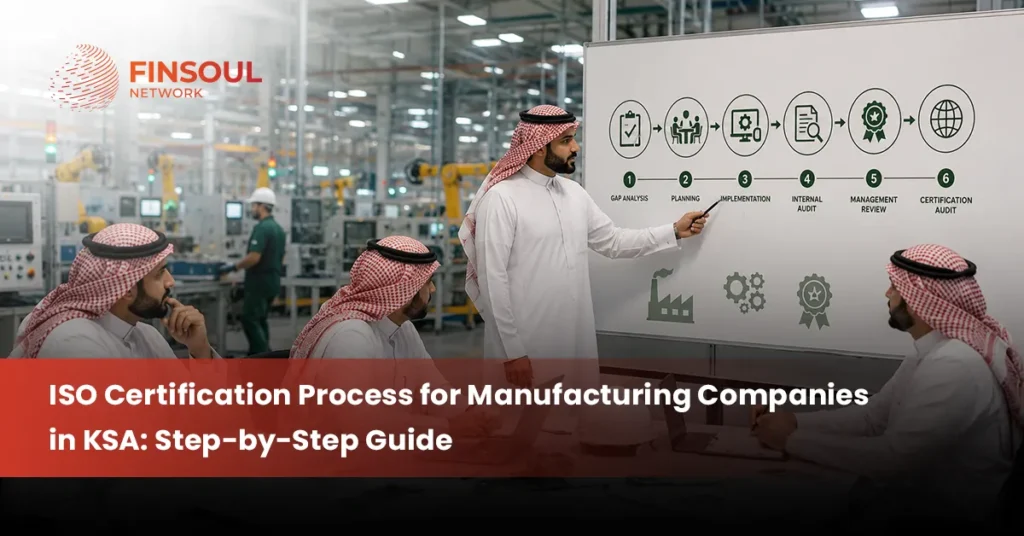
A buyer in Riyadh or Jeddah asks for proof of quality standards, and suddenly a factory owner is scrambling to understand what certification even involves. ISO certification for manufacturing companies in KSA is not just a compliance checkbox anymore. It has become a real requirement for winning government tenders, entering export markets, and satisfying corporate buyers who will not sign a contract without it. Finsoul Network KSA works with manufacturers across the Kingdom to move through this process without the guesswork, and this guide breaks down exactly what each stage involves, step by step.
Why Manufacturers in KSA Need ISO Certification
Saudi Arabia’s Vision 2030 push has pulled manufacturing into the spotlight, with local production increasingly expected to meet international benchmarks. Government procurement, SASO regulations, and private-sector supply chains now routinely list certification as a prerequisite rather than a bonus. For factories exporting into Europe or the Gulf Cooperation Council, having a recognized quality system in place often decides whether a shipment even clears the first round of vendor screening.
Choose the Right ISO Standard for Your Operation
Not every certification fits every factory. ISO 9001 covers general quality management and suits most manufacturers as a starting point. ISO 14001 applies to environmental management and matters for factories with heavy emissions or waste output. ISO 45001 covers occupational health and safety, which is increasingly requested by construction-linked manufacturing suppliers. Picking the wrong standard, or trying to pursue all three before the business is ready, is one of the most common reasons the ISO certification process Saudi Arabia stretches out longer than it should.
Conduct a Gap Analysis
Before applying anywhere, an internal or third-party gap analysis compares current operations against the chosen standard’s requirements. This step surfaces missing documentation, inconsistent quality checks, or safety gaps early, when they are cheap to fix, rather than during a formal audit when they can delay the entire certification timeline.
Build or Update the Quality Management System
This is usually the longest phase in ISO certification for manufacturing companies in KSA projects. It involves documenting procedures, defining roles and responsibilities, setting measurable quality objectives, and creating records that prove the system is actually being followed day to day rather than existing only on paper.
Train Staff and Run Internal Audits
A quality management system only works if the people on the floor understand it. Training sessions cover how to log defects, how to escalate non-conformities, and how new procedures change daily routines. Internal audits then test whether the system holds up under real conditions before an external auditor ever walks through the door, a stage many factories underestimate during ISO certification for manufacturing companies in KSA projects.
Select an Accredited Certification Body
Certification bodies must be accredited to issue valid ISO certificates recognized internationally. Manufacturers should confirm accreditation status directly rather than assuming, since a certificate from an unaccredited body carries little weight with export customers or government tenders. This choice materially affects how smoothly the ISO certification process Saudi Arabia moves toward completion.
Complete the Certification Audit
The certification audit runs in two stages. Stage one reviews documentation and readiness. Stage two examines the system in actual operation, checking whether processes on the shop floor match what the paperwork claims. Auditors typically flag minor non-conformities that need correction before the certificate is issued, and major ones that require a follow-up visit.
Receive Certification and Maintain It
Once the audit closes out successfully, the certificate is issued, usually valid for three years with annual surveillance audits in between. ISO certification Saudi Arabia bodies expect continuous compliance, not a one-time effort, so factories need to keep records current and repeat internal audits regularly to avoid losing certification at the next review.
ISO Certification Requirements Manufacturers Should Prepare in Advance
Meeting the core ISO certification requirements for ISO certification for manufacturing companies in KSA ahead of time speeds up every stage above. The table below summarizes what is typically needed.
| Requirement | Why It Matters |
| Documented quality manual | Forms the backbone of the management system auditors review |
| Process maps and procedures | Show how each production stage is controlled and monitored |
| Trained internal audit team | Demonstrates ongoing self-monitoring between external audits |
| Non-conformity and corrective action log | Proves the factory addresses problems systematically |
| Management review records | Confirms leadership actively oversees the quality system |
Common Challenges Manufacturers Face
Several recurring issues slow down ISO certification for manufacturing companies in KSA projects for factories across the Kingdom:
- Treating documentation as a one-time exercise instead of a living system
- Underestimating the time needed to train shop-floor staff properly
- Choosing a certification body without checking accreditation first
- Failing to close out minor non-conformities before the audit deadline
- Losing certification later due to skipped surveillance audits
Avoiding these pitfalls keeps the ISO certification process Saudi Arabia manufacturers go through predictable rather than a source of repeated delays.
How Long Does the Process Typically Take
Timelines vary by factory size and how mature existing quality practices already are. A small to mid-sized manufacturer with reasonably organized processes can often complete ISO certification for manufacturing companies in KSA requirements within three to six months. Larger, more complex operations, or those starting from limited documentation, should plan for six to twelve months to move through gap analysis, system building, training, and the audit stages without cutting corners.
What Certification Typically Costs
Budgeting for ISO certification for manufacturing companies in KSA involves more than simply paying the certification audit fee. The overall cost depends on several factors, including the size of the factory, number of employees, operational complexity, and the ISO standard being pursued.
| Cost Factor | What It May Include |
| Certification audit fee | External audit conducted by an accredited certification body |
| Gap analysis | Assessment of existing processes against ISO requirements |
| Consultant support | Assistance with documentation, implementation, and preparation |
| Employee training | Training staff on ISO procedures, quality systems, and compliance |
| Documentation | Developing policies, procedures, process records, and manuals |
| Internal audits | Reviewing the management system before the external certification audit |
| Process improvements | Operational changes required to address identified gaps |
| Equipment upgrades | Additional tools or systems needed to meet relevant ISO requirements |
Factories that budget for these costs from the beginning can avoid funding delays during the ISO certification Saudi Arabia process. Smaller manufacturers may also choose to start with ISO 9001 and later add ISO 14001 or ISO 45001 once their first management system is established, and the investment is easier to manage.
Choosing Between In-House Preparation and Consulting Support
Some manufacturers try to run ISO certification for manufacturing companies in KSA projects entirely in-house, assigning the task to an existing quality manager alongside their regular duties. This can work for smaller operations with simple processes, but it often stretches timelines because the person leading certification rarely has the bandwidth to also document every procedure from scratch.
Bringing in outside support for the gap analysis and documentation stages, even briefly, tends to shorten the overall ISO certification process Saudi Arabia manufacturers experience, since consultants have already seen what auditors typically flag and can help avoid repeat visits.
Final Thoughts
Certification is not a formality that gets filed away after the audit. It is a working system that shapes how a factory operates every day, from how defects get logged to how leadership reviews performance. Manufacturers that treat ISO certification requirements as an ongoing discipline rather than a one-time project tend to pass surveillance audits with far less stress. Finsoul Network KSA supports factories through every stage of this journey, from the first gap analysis to final certificate issuance and beyond.
Ready to Get ISO Certified?
Make your manufacturing business audit-ready and strengthen your chances of winning government tenders and corporate contracts. Get expert support with gap analysis, documentation, staff training, internal audits, and the certification process from start to finish.
Get in touch with Finsoul Network KSA today and take the first step toward ISO certification for your manufacturing business in KSA.
Our Location
Office 201 (4th Floor), SQ Tower, GCC Road, Al Khuzamah, Eastern Province, Al Khobar, Kingdom of Saudi Arabia
Email
info@finsoulnetwork.com
Contact
+966 54 865 6146
Frequently Asked Questions
Which ISO standard should a manufacturer in KSA start with?
ISO 9001 is the most common starting point since it covers general quality management applicable to nearly every manufacturing operation.
How long does ISO certification usually take for a factory in Saudi Arabia?
Most manufacturers complete the process in three to six months, though larger or less organized operations may need up to a year.
Is ISO certification mandatory for government tenders in KSA?
Many government and large private contracts now list certification as a prerequisite, especially for suppliers bidding on manufacturing or industrial contracts.
What happens if a factory fails the certification audit?
Auditors issue a list of non-conformities that must be corrected, and the factory is typically given a set period to fix issues before a follow-up review.
Does ISO certification expire?
Yes, certificates are usually valid for three years and require annual surveillance audits to remain active and recognized.