
A Saudi startup does not need ISO certification simply because it has raised funding, hired more employees or reached a particular valuation. For many early-stage businesses, certification would add cost and administration before there is a strong commercial reason for it.
The picture changes as the startup grows. Enterprise customers may introduce supplier requirements, government opportunities can involve formal qualification criteria, regulated sectors create additional compliance expectations, and international expansion makes independently verified management systems more valuable.
That makes the real question around ISO certification for startups in Saudi Arabia more practical than it first appears:
At what stage does ISO certification solve a real business problem rather than become another badge on the company website?
For some startups, the answer may be before a major enterprise contract. For others, it may come after Series A or during regional expansion. And some businesses may operate successfully for years without needing certification at all.
Is ISO Certification Mandatory for Saudi Startups?
There is no general rule requiring every startup in Saudi Arabia to obtain ISO certification.
ISO standards are international standards, while certification is an independent conformity-assessment process. ISO itself does not certify companies or issue ISO certificates. Certification is carried out by external certification bodies.
Whether certification becomes necessary depends on the startup’s circumstances. A customer contract may require it. A tender may specify a particular standard. An investor may expect stronger governance as the company scales. A regulated activity may have separate requirements that overlap with an ISO management system.
This distinction is important when discussing ISO certification requirements Saudi Arabia. A requirement coming from a customer or tender is not automatically a national legal requirement, and an ISO certificate does not automatically prove compliance with every Saudi regulation.
Funding Stage Is a Useful Guide, Not a Certification Rule
Funding stage can indicate how mature a startup has become, but it should not determine certification by itself.
A bootstrapped B2B cybersecurity company handling sensitive enterprise information may encounter ISO 27001 requirements earlier than a Series A consumer marketplace. Similarly, a manufacturing startup may face ISO 9001 expectations because of its supply chain even while the company remains relatively small.
The better model is to use funding stage as a way to ask what has changed in the business.
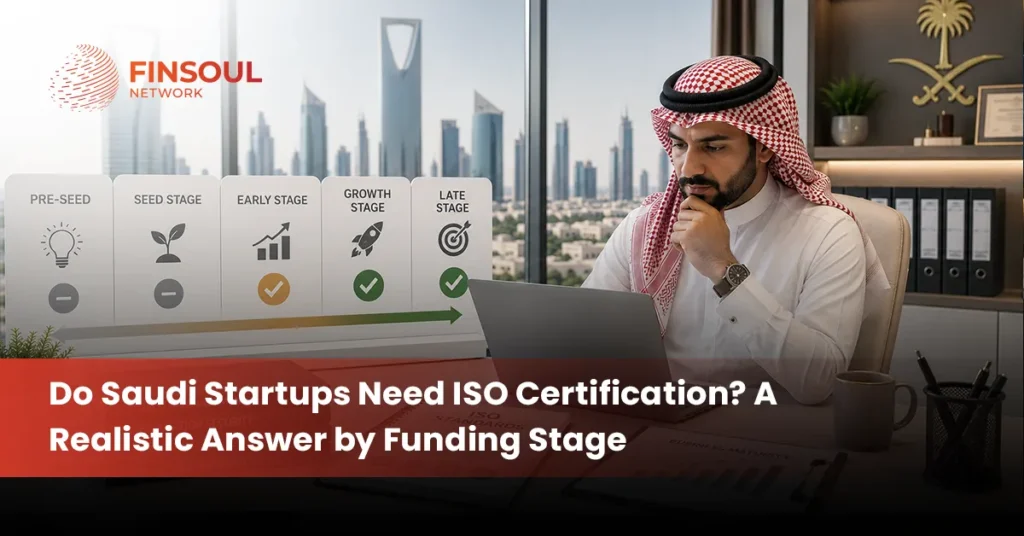
| Startup stage | Typical ISO priority |
| Idea / Pre-seed | Usually low |
| Seed | Selective |
| Series A | Increasing |
| Series B and growth | Often commercially relevant |
| Enterprise scale | Frequently part of formal governance |
| International expansion | Depends strongly on market and customers |
The important trigger is not the funding announcement. It is the operational complexity and customer expectation that often arrive around the same stage.
Pre-Seed: Certification Is Usually Too Early
At pre-seed stage, founders are normally validating the product, market and business model. Cash and management attention are limited, processes are changing quickly and the organisation may have only a small team.
In this environment, formal certification can be premature.
A startup should not build an elaborate management system for processes that may look completely different six months later. That can create documentation that employees maintain for an audit rather than controls that improve the business.
However, this does not mean ISO standards are irrelevant.
A pre-seed startup can use principles from relevant standards without seeking certification. A software company can begin establishing information-security responsibilities. A product startup can document repeatable quality checks. A health or safety-sensitive business can build risk controls early.
The better pre-seed objective is often ISO readiness, not ISO certification.
This creates cleaner foundations without diverting disproportionate resources away from product-market fit.
Seed Stage: Start Looking at Your Customer Pipeline
At seed stage, the certification question becomes more commercial.
The startup may now have paying customers, a growing workforce and a clearer product. Founders should examine what larger prospects are asking during sales and vendor onboarding.
If security questionnaires repeatedly ask whether the company holds ISO/IEC 27001 certification, that is evidence of an emerging requirement. If manufacturing customers expect a certified quality management system, ISO 9001 may deserve earlier attention.
A Saudi startup ISO certification decision at this stage should therefore begin with evidence from the market.
Look at:
- Lost deals: Did the absence of certification contribute to the decision?
- Security reviews: Are enterprise clients requesting independent assurance?
- Tender requirements: Does certification appear in qualification criteria?
- Customer contracts: Are specific standards being made contractual?
- Operational failures: Would a structured management system solve recurring problems?
- Growth plans: Will upcoming markets or customer segments introduce stronger assurance requirements?
If the answers are mostly no, certification may still be unnecessary.
Series A: ISO Can Move From Optional to Commercially Useful
Series A often changes the nature of the company.
The startup may be moving beyond founder-led operations, hiring department heads, formalising policies and targeting larger customers. Informal ways of managing security, quality or service delivery become harder to maintain as headcount and transaction volume increase.
At this point, certification can begin serving two purposes.
The first is external assurance. Enterprise customers may want independent evidence that the startup has established appropriate management controls.
The second is internal discipline. A management-system standard can force the organisation to define responsibilities, assess risks, document important processes, monitor performance and correct recurring weaknesses.
The decision should still be tied to a specific problem. “We just raised Series A” is not a sufficient reason. “Three target banks require ISO 27001 during vendor onboarding” is much stronger.
Series B and Growth Stage: The Business Case Becomes Stronger
By Series B or a comparable growth stage, a startup may have multiple products, larger teams, more suppliers and a significant enterprise customer base.
The cost of inconsistent processes also rises.
A security incident can affect major contracts. Quality failures can damage customer retention. Poor service management can disrupt enterprise accounts. Weak business-continuity planning can become unacceptable when customers depend on the platform.
Certification can therefore become part of a wider governance architecture rather than an isolated compliance project.
For many growth-stage businesses, the question shifts from:
“Do we need an ISO certificate?”
to:
“Which management systems actually correspond to our risks and customer requirements?”
That is a healthier question because not every growing startup needs the same ISO standard.
Which ISO Standards Are Most Relevant to Saudi Startups?
The right standard depends on what the startup does.
| Standard | Where it may become relevant |
| ISO 9001 | Quality management and repeatable delivery |
| ISO/IEC 27001 | Information-security management |
| ISO 22301 | Business continuity management |
| ISO 45001 | Occupational health and safety |
| ISO 14001 | Environmental management |
| ISO 37001 | Anti-bribery management |
| ISO 37301 | Compliance management |
A software startup should not pursue ISO 14001 simply because another company displays it. A low-risk professional-services startup may have little immediate reason for ISO 45001 certification. A fintech handling sensitive information may find ISO 27001 far more relevant than ISO 9001 at its current stage.
The certification portfolio should follow material risks and market expectations.
When Does ISO 27001 Make Sense for a Saudi Tech Startup?
For technology businesses, ISO/IEC 27001 is often one of the first standards considered because enterprise customers care about how suppliers protect information.
The standard establishes requirements for an Information Security Management System. It applies to organisations of different sizes, including SMEs, and uses a risk-based approach rather than assuming every company requires identical security controls.
For a Saudi SaaS, fintech, health-tech or data-intensive startup, the business case becomes stronger when it begins handling sensitive customer information, integrating with major enterprise systems or facing detailed third-party security assessments.
But certification should not be confused with Saudi cybersecurity compliance.
ISO 27001 Does Not Replace Saudi Cybersecurity Requirements
This distinction is particularly important in 2026.
Saudi Arabia’s National Cybersecurity Authority maintains national cybersecurity controls and guidance. The current Essential Cybersecurity Controls are ECC 2-2024, and the NCA also maintains specialised controls covering areas such as cloud and data cybersecurity.
The regulatory landscape has continued developing. NCA also issued cybersecurity controls for private-sector entities without critical infrastructure in December 2025, establishing minimum cybersecurity controls for the entities within that document’s scope.
Financial-sector startups may face another layer. The Saudi Central Bank’s Cyber Security Framework applies within its defined scope to sectors including banking, finance, payment systems and payment service providers, credit bureaus and the regulatory sandbox.
An ISO 27001 certificate can support a mature security programme, but it should not be treated as automatic evidence that every applicable NCA or SAMA requirement has been satisfied.
A regulated startup needs to identify its Saudi requirements separately and map its controls accordingly.
When Does ISO 9001 Become Worth Considering?
ISO 9001 can be useful when quality is becoming difficult to manage through informal founder oversight.
ISO itself confirms that ISO 9001 requirements are intended to be applicable to organisations regardless of their type or size. Guidance specifically exists to help smaller enterprises apply the quality-management approach.
For a Saudi startup, ISO 9001 may become more relevant when:
- Delivery needs consistency across teams
- Customers are auditing supplier quality
- Recurring errors are affecting service
- The startup is entering structured supply chains
- Tender requirements mention quality certification
- Operations span multiple sites or departments
- Management needs measurable quality objectives
The key is operational need. Certification should improve or validate a functioning quality system rather than create a parallel bureaucracy that employees use only before audits.
Do Investors Actually Require ISO Certification?
Investors can care about the issues ISO standards address without requiring an ISO certificate itself.
At early stage, investors are more likely to focus on the team, market, product, growth, unit economics and risk. As the business matures, due diligence can become deeper around cybersecurity, compliance, operational resilience, governance and customer concentration.
Certification can support that discussion because it provides independent assurance around a defined management system.
But founders should avoid assuming:
“Certification will make us fundable.”
ISO certification does not repair weak economics, poor product-market fit or an unsustainable growth model.
Its value is strongest where management maturity and assurance have become relevant to the risks investors or strategic partners are evaluating.
Enterprise Customers Can Create the Real Certification Deadline
For B2B startups, the strongest ISO trigger often comes from procurement rather than fundraising.
A startup may reach the final stages of an enterprise sale and encounter requirements it never saw when selling to smaller customers.
Procurement can ask for security policies, business-continuity plans, penetration-test evidence, data-processing controls, insurance, certifications and other supplier-assurance documentation.
At that point, certification can affect revenue directly.
This is why founders should examine future customers before waiting for a deal to stall. If the next target segment consistently expects ISO 27001 or ISO 9001, readiness work can begin before certification becomes an emergency.
What About Government and Large Saudi Contracts?
Government and large-enterprise procurement can involve formal qualification requirements, but startups should not assume that one ISO certificate universally unlocks Saudi tenders.
Requirements vary according to the buyer, procurement exercise, product, service and sector.
A tender may specify a particular certification. Another may emphasise cybersecurity, technical capability, localisation or other eligibility requirements. Some supply chains may impose their own management-system expectations.
The correct approach is to review the actual tender or procurement conditions.
Never obtain ISO certification purely because someone says “government contracts require ISO.” Verify which standard, which scope and whether certification is actually mandatory for the opportunity being targeted.
International Expansion Changes the Calculation
A Saudi startup entering new markets faces a credibility problem.
Potential customers may know little about the company. Enterprise buyers need ways to evaluate whether an unfamiliar supplier can manage security, quality and operational risk.
Recognised management-system certification can reduce part of that uncertainty.
ISO 27001 can provide internationally understandable information-security assurance. ISO 9001 can demonstrate that a quality management system has been independently assessed. Other standards can become relevant according to the sector.
This does not mean certification guarantees international sales. It means a recognised assurance mechanism can remove one question from a buyer’s due-diligence process.
For startups expanding from Saudi Arabia into the wider GCC, Europe, Asia or other markets, that portability can make certification more commercially useful than it was during the domestic early stage.
What Are the Real ISO Certification Requirements in Saudi Arabia?
There is no single checklist called ISO certification requirements Saudi Arabia that applies identically to every startup and every ISO standard.
The requirements begin with the specific standard being pursued.
A company seeking ISO 9001 certification must implement a quality management system conforming to the applicable ISO 9001 requirements. A company seeking ISO/IEC 27001 certification must establish an ISMS meeting that standard’s requirements.
Certification is then performed by an independent certification body, not ISO itself.
Before starting, a startup should establish:
- Which standard is commercially or operationally relevant
- What legal entity and activities will be in scope
- Which sites, systems or services are included
- Who will own the management system
- Which gaps exist against the standard
- What records will demonstrate implementation
- Whether internal audit and management review are ready
- What certification body will perform the assessment
The exact requirements then depend on the chosen standard.
The Hidden Cost Is Not the Certificate
Startups often focus on the certification body’s fee. That is only part of the cost.
Management time can be more significant.
Processes need owners. Risk assessments need to reflect reality. Employees need to understand responsibilities. Controls need evidence. Internal audits need independence. Nonconformities need corrective action.
If the startup builds hundreds of unnecessary documents simply to appear “ISO ready,” the management system can become a burden.
A lean startup should therefore apply the standard proportionately. ISO requirements such as those in ISO 9001 and ISO/IEC 27001 are designed to be applicable across different organisation sizes; being small does not mean creating an enterprise-sized compliance department.
A Better Funding-Stage Decision Framework
Instead of automatically connecting certification to a funding round, founders can use a trigger-based test.
| Question | If the answer is yes |
| Are target customers requesting certification? | Certification may now affect revenue |
| Is it appearing in tenders? | Assess the exact qualification requirement |
| Are enterprise security reviews slowing deals? | Consider ISO 27001 where relevant |
| Are quality failures increasing with scale? | Evaluate ISO 9001 |
| Is the startup entering a regulated sector? | Map regulatory requirements first |
| Is international expansion starting? | Certification may improve portable assurance |
| Are processes becoming inconsistent across teams? | A management system may add internal value |
| Is there no clear customer, regulatory or operational driver? | Certification may still be premature |
This framework prevents the startup from treating ISO as a milestone that automatically follows Seed, Series A or Series B.
When Should a Saudi Startup Wait?
Waiting can be the correct decision.
A startup should question immediate certification if its product is still changing radically, the certification scope cannot be defined sensibly, no important customer requests it and the team does not yet have stable processes to manage.
The startup can still use ISO principles.
Building basic risk management, access controls, quality processes, incident response, document ownership and internal accountability early can make eventual certification easier without paying the full organisational cost before there is a reason.
This approach preserves flexibility while avoiding a compliance scramble later.
When Should a Saudi Startup Stop Waiting?
The opposite mistake is postponing certification until an enterprise customer creates a deadline the startup cannot realistically meet.
Warning signs include repeated certification questions in RFPs, security reviews becoming longer, major prospects making certification a condition, regulated customers requesting stronger assurance or international buyers asking for independent evidence of management controls.
At that stage, certification is no longer mainly a branding exercise.
It has become part of market access.
The Real Answer Depends on What the Startup Is Becoming
ISO certification for startups in Saudi Arabia should not be treated as an automatic requirement at incorporation, Seed, Series A or any other funding milestone.
Pre-seed companies will often gain more from building sensible foundations than pursuing immediate certification. Seed-stage startups should start listening closely to customer and tender requirements. At Series A, formal management systems can become useful as enterprise sales and organisational complexity increase. By later growth stages, certification may form part of a wider governance and customer-assurance strategy.
Saudi-specific regulation remains a separate consideration. NCA cybersecurity controls, SAMA requirements and other sector obligations must be assessed directly where they apply; an ISO certificate should not be presented as a universal substitute.
For ISO Consultants KSA, the most useful way to evaluate the 2026 landscape is therefore not “When should every startup become certified?” but “What business, customer or regulatory problem would certification solve at this company’s current stage?”
When there is no convincing answer, waiting may be rational. When certification begins deciding whether the startup can enter a tender, satisfy an enterprise customer or support its next phase of scale, the timing has changed.
FAQs
Is ISO Certification Mandatory for Startups in Saudi Arabia?
No general rule makes ISO certification mandatory simply because a business is a startup in Saudi Arabia. Certification can become relevant because of a specific regulator, customer, contract, tender or supply-chain requirement. Startups should verify the requirement applicable to their sector and opportunity rather than assuming every Saudi company must be ISO certified.
Which ISO Certification Is Best for a Saudi Startup?
There is no single best certification for every startup. ISO 9001 may suit businesses needing stronger quality management, while ISO/IEC 27001 can be particularly relevant to technology companies handling sensitive information. ISO 22301, ISO 45001, ISO 14001 or other standards may become appropriate depending on operational risks, customers and sector.
Does a Saudi Tech Startup Need ISO 27001?
Not automatically. A tech startup may consider ISO/IEC 27001 when enterprise customers request information-security certification, sensitive data becomes material to operations or international expansion creates stronger assurance requirements. Applicable Saudi cybersecurity obligations, including NCA or SAMA requirements where relevant, still need to be assessed independently.
Should a Startup Get ISO Certification Before Series A?
Only where there is a clear reason. A pre-Series A startup may benefit from certification if a major enterprise contract, tender or sector requirement depends on it. If processes remain unstable and no customer or regulatory driver exists, building ISO-aligned foundations without immediate certification may use resources more effectively.
Does ISO Certification Help Saudi Startups Win Enterprise Clients?
It can help when enterprise procurement teams use certification as evidence of management-system maturity or include it in supplier qualification. However, certification does not guarantee a contract. Customers may also examine scope, cybersecurity evidence, financial stability, service performance, regulatory compliance and other vendor risks before approving a startup.