
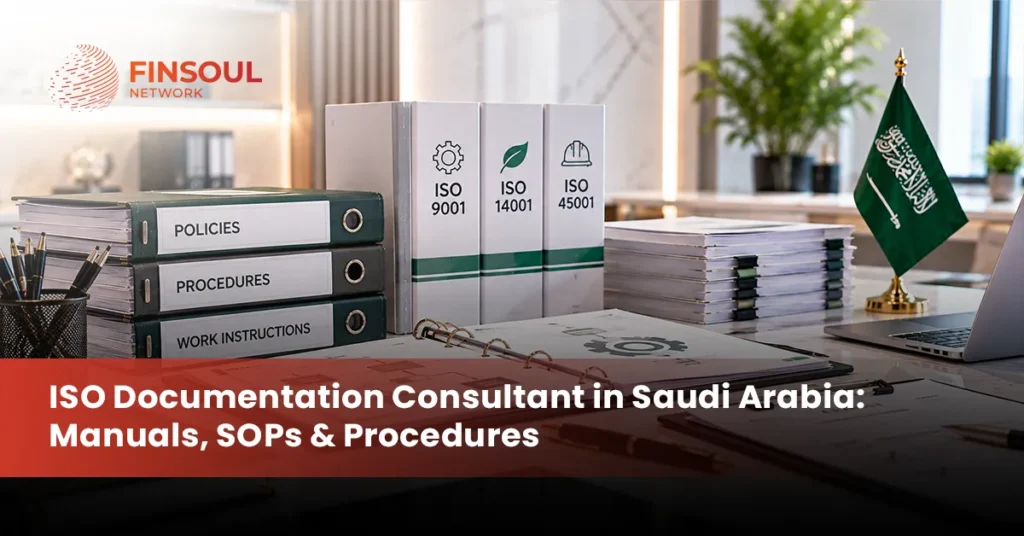
Imagine your auditor arrives on Sunday morning and asks for your quality manual. Someone digs up a file from 2019, another team follows a different procedure, and nobody can find the latest revision. Many Saudi companies stall at certification for exactly this reason: their operations are sound, but their paperwork cannot prove it.
A skilled ISO documentation consultant in KSA closes that gap quickly and without disrupting daily work. In this guide, Finsoul Network KSA explains what goes wrong, what auditors expect, and how to build documentation that supports both certification and everyday operations.
The Real Problem: Paperwork That Doesn’t Match Practice
Most certification delays trace back to documents, not processes. Teams download generic templates, replace the company name, and consider the job complete. The result is a manual that describes a company that does not actually exist, and auditors can spot this within minutes.
Common symptoms include:
- Procedures nobody has read or follows
- Missing records for training, calibration, or corrective actions
- Version confusion between departments
- SOPs written in language staff cannot easily follow
Weak ISO documentation in KSA can also cause problems after certification. Surveillance audits take place regularly, and gaps found during these audits can lead to nonconformities or other compliance issues. That is why many companies engage an ISO documentation consultant in KSA before the first audit rather than waiting until problems appear.
Understanding ISO Documentation Requirements: What Auditors Expect
The ISO documentation requirements differ slightly between standards, but the principle is straightforward: document the information needed to control your processes and maintain evidence that those processes are being followed.
Newer standards such as ISO 9001:2015 do not require every company to maintain a fixed list of procedures. Instead, they require documented information appropriate to the organisation’s size, complexity, processes, and risks.
That flexibility can become a challenge. Too little documentation may leave gaps, while excessive paperwork can make the system difficult for employees to use. The table below shows four common documentation layers.
| Document Layer | Purpose | Typical Example |
| Manual | Defines scope, policy, and process interaction | Quality or integrated management manual |
| Procedures | Explain who does what and when | Document control, internal audit, corrective action |
| SOPs / Work Instructions | Give step-by-step task guidance | Equipment calibration, goods inspection |
| Forms & Records | Prove the work was completed | Training logs, audit reports, inspection sheets |
Each layer supports the one above it. When a layer is missing, the chain can break. An auditor may ask for evidence of a process, and if the required record cannot be produced, a nonconformity may follow.
The Solution: Work With an ISO Consultant Saudi Arabia Businesses Can Rely On
A reliable ISO consultant Saudi Arabia businesses can depend on does not simply hand you a template pack. The consultant studies how your teams actually work and develops documentation around those processes.
A typical engagement includes:
- Gap assessment: Compare existing documents with the applicable standard.
- Document plan: Decide what needs to be created, updated, merged, or removed.
- Drafting: Develop manuals, procedures, SOPs, forms, and supporting documents.
- Staff review: Allow employees responsible for each process to verify accuracy.
- Training and rollout: Make sure employees understand and use the documentation.
- Audit support: Conduct pre-audit checks and address remaining gaps.
This approach keeps documents practical, concise, and audit-ready. It also saves internal time because the consultant manages the documentation work while your team provides operational knowledge.
Writing Manuals, SOPs, and Procedures the Right Way
The manual should remain lean. It should cover your scope, policy, objectives, and process interactions while leaving operational details to the procedures beneath it.
Procedures should answer four key questions: who does the work, what is done, when it is done, and which record proves completion. If a procedure cannot answer these questions clearly, it may need revision.
SOPs are written for the person performing the task, not simply for the auditor. Use numbered steps, short sentences, and photos or diagrams where they add value. If a new employee cannot understand an SOP after reading it once, simplify it.
Language also matters. Many Saudi workplaces operate in both Arabic and English, so bilingual SOPs can help prevent misunderstandings and improve employee adoption. An experienced ISO documentation consultant in KSA can also help align documentation with applicable Saudi requirements and sector-specific expectations.
How to Choose the Right ISO Documentation Consultant in KSA
Not every consultant delivers the same quality. Before signing an agreement, check for:
- Experience with your industry and relevant standards, such as ISO 9001, 14001, 45001, or 27001
- Sample documents that are clear and practical rather than unnecessarily complex
- A written timeline and defined deliverables
- Support beyond the initial documentation stage
- Evidence of experience supporting clients through certification audits
Ask an ISO documentation consultant in KSA to show a sample SOP and explain how it would be adapted to your actual operation.
Also confirm that the consultant understands the ISO documentation requirements for your specific standard. ISO 27001, for example, requires a different documentation approach from ISO 14001 because the risks, controls, and evidence involved are different.
Be cautious of consultants who promise certification within a few days or provide identical document packs to every client. Generic shortcuts can create serious gaps when auditors compare your documentation with actual business practices.
Keeping ISO Documentation in KSA Audit-Ready
Creating documents is only half the job. To maintain an effective system:
- Assign an owner to every controlled document
- Review documents regularly and whenever processes change
- Use a clear numbering and revision system
- Remove outdated copies from work areas
- Train new employees on relevant SOPs
- Keep records that demonstrate implementation
Good ISO documentation in KSA should function as a living management system rather than a one-time certification exercise.
Final Thoughts:
Strong documentation does more than support certification. It can make employee training easier, reduce process errors, improve consistency, and give managers better visibility over operations.
Choosing the right ISO documentation consultant in KSA can turn a stressful compliance task into a practical management system that continues to support your business after certification.
Need Help With ISO Documentation in Saudi Arabia?
Finsoul Network KSA can help your business develop clear manuals, practical SOPs, procedures, forms, and audit-ready records based on your actual operations.
Whether you are preparing for your first certification audit or improving an existing management system, our team can help identify documentation gaps and create a structured plan for improvement.
Contact Finsoul Network KSA today to discuss your ISO documentation needs and get professional support for a smoother certification journey.
Our Location
Office 201 (4th Floor), SQ Tower, GCC Road, Al Khuzamah, Eastern Province, Al Khobar, Kingdom of Saudi Arabia
Email
info@finsoulnetwork.com
Contact
+966 54 865 6146
Frequently Asked Questions
What does an ISO documentation consultant in KSA do?
They assess your current system and develop or improve manuals, procedures, SOPs, forms, and records to support compliance with the applicable standard. They may also provide employee training and audit preparation support.
How long does ISO documentation take?
Small and mid-sized companies may complete documentation within four to twelve weeks, depending on the scope, standard, number of processes, and availability of staff. Multi-site or complex organisations may require more time.
Do I need Arabic documents for certification?
ISO standards generally focus on whether documented information is understood and effectively used rather than requiring one specific language. Bilingual documentation can be useful in Saudi workplaces where employees use both Arabic and English.
Can I write the documents myself?
Yes. However, internal teams may find the process time-consuming, particularly when they are unfamiliar with the standard. Working with an ISO consultant Saudi Arabia with relevant expertise can help reduce documentation gaps and improve audit preparation.
What are the main ISO documentation requirements?
Organisations generally need appropriate documented information covering areas such as scope, policies, objectives, controlled processes, and evidence of implementation. The exact ISO documentation requirements depend on the applicable ISO standard and the organisation’s circumstances.