
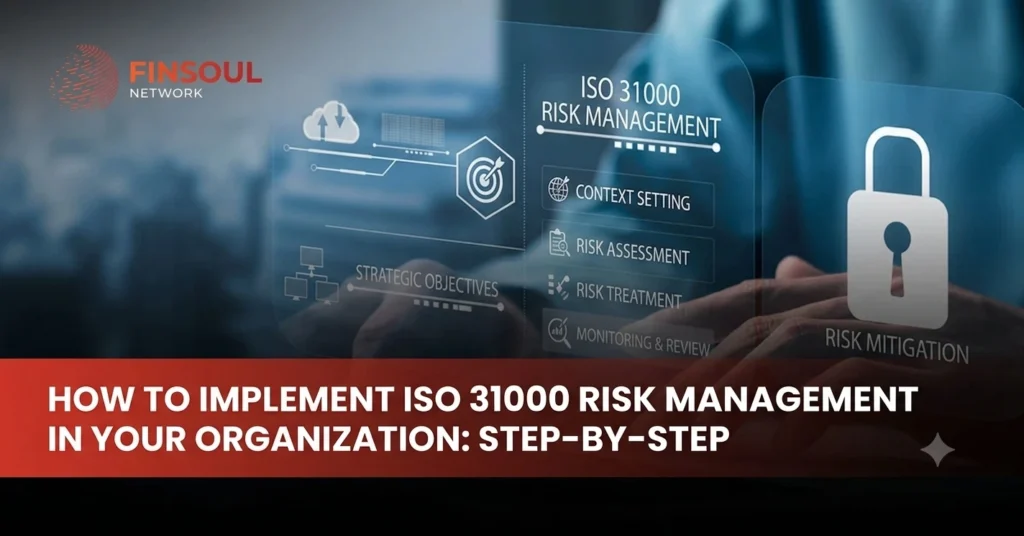
In today’s unpredictable business environment, the ability to anticipate and manage uncertainty separates resilient organizations from vulnerable ones. ISO 31000 risk management is the internationally recognized standard that gives organizations of every size and sector a proven, flexible approach to managing risk without overhauling existing systems or processes.
Whether you lead a financial institution, a construction firm, or a government entity, this guide will walk you through the framework, the process, and the practical steps required to embed risk management into the way your organization thinks and operates. At Finsoul Network KSA, we have helped organizations across Saudi Arabia and the GCC implement structured risk governance systems aligned with international best practices. Here is everything you need to get started.
What Is ISO 31000?
Published by the International Organization for Standardization, ISO 31000 is a global guideline, not a certification, designed to help organizations manage risk consistently and effectively. Updated most recently in 2018, it applies across all industries without requiring modifications to existing management systems.
The standard rests on three pillars:
- Principles: Eight core values that define what good risk management looks like
- Framework: The organizational structure for integrating risk management into governance and strategy
- Process: The operational steps for identifying, analyzing, evaluating, and treating risk
Together, these components form the ISO 31000 risk management framework: a comprehensive, adaptable system that turns risk awareness into strategic action.
Why Organizations Adopt This Standard
This globally recognized framework delivers measurable business value beyond mere compliance:
- Better decision-making: Executives equipped with risk data make more confident, better-informed choices
- Stakeholder confidence: Structured risk oversight builds trust with clients, investors, and regulators
- Regulatory alignment: The framework supports compliance with local governance and international standards
- Operational resilience: Organizations recover faster from disruptions when risk management is embedded in daily work
- Cultural shift: Risk awareness moves from a siloed department function to a company-wide mindset
For organizations in regulated sectors banking, energy, real estate, and healthcare implementing a structured approach to risk is increasingly expected by boards, government bodies, and international partners.
The ISO 31000 Risk Management Process: Step-by-Step
This process is cyclical and ongoing, not a checklist to complete once. It is driven by continuous communication, monitoring, and improvement across seven core activities.
Step 1: Establish the Context
Before identifying risks, define the environment in which your organization operates. This means clarifying your strategic objectives, stakeholder expectations, regulatory obligations, and existing controls. Context-setting ensures that your risk criteria are aligned with real business priorities, not generic templates.
Step 2: Risk Identification
Systematically identify what could prevent your organization from achieving its goals or what opportunities might emerge from uncertainty. Useful tools include SWOT and PESTLE analysis, cross-functional brainstorming workshops, historical incident data, and process mapping. All findings are captured in a risk register, the living document at the heart of your risk system.
Step 3: Risk Analysis
Assess the likelihood and potential impact of each identified risk. Analysis can be qualitative (descriptive scales), quantitative (financial modeling), or semi-quantitative (a blend of both). The output feeds directly into the next step, enabling objective prioritization of risks.
Step 4: Risk Evaluation
Compare analyzed risks against your predefined tolerance levels. A risk matrix helps visualize which risks need immediate treatment, which can be monitored, and which fall within acceptable limits. This is where strategic trade-offs become clear.
Step 5: Risk Treatment
Develop a treatment plan for unacceptable risks. The four standard options are:
- Avoid eliminate the activity generating the risk
- Reduce apply controls to lower likelihood or impact
- Transfer share the risk through insurance or contractual agreements
- Accept retain residual risk within defined tolerance thresholds
Each action should be assigned an owner, a deadline, and measurable success criteria.
Step 6: Monitoring and Review
The risk management process as per ISO 31000 is not static it must evolve as your organization and its environment change. Schedule formal reviews at regular intervals (quarterly at minimum) and embed informal monitoring into day-to-day operations. This ensures controls remain effective and your risk register stays current.
Step 7: Communication and Consultation
This activity runs continuously alongside every other step. Keeping internal and external stakeholders informed and consulted improves the quality of risk data, accelerates decision-making, and secures the organizational buy-in needed for sustained success.
How to Implement ISO 31000 in Your Organization
Understanding the process is essential, but execution requires deliberate planning. Here is a practical, phased roadmap:
- Secure Leadership Commitment: Risk management requires executive sponsorship. Boards and senior management must allocate resources, set risk appetite, and model risk-aware behavior from the top.
- Develop a Risk Policy: Document your organization’s risk appetite, tolerance thresholds, and the principles that guide all risk decisions.
- Assign Roles and Responsibilities: Designate Risk Owners for each risk category and establish a Risk Committee or dedicated Risk Manager to oversee the process.
- Build Capability Across Teams: The risk management process as per ISO 31000 requires participation at all levels. Deliver targeted training so every department understands its role and responsibilities.
- Use Technology Wisely: Risk management platforms streamline documentation, automate alerts, and generate real-time dashboards, making the overall process more consistent and auditable.
- Integrate with Strategic Planning: Embed risk considerations into annual planning cycles, investment decisions, and project management frameworks so risk informs strategy from the start.
- Review, Audit, and Improve: Conduct regular risk management audits to assess effectiveness, identify gaps, and drive continual improvement. ISO 31000 is a living system, not a static document.
At Finsoul Network KSA, our certified risk advisors support organizations through every phase, from initial gap assessments and risk appetite workshops to full-scale implementation and ongoing monitoring.
Common Challenges and How to Overcome Them
- Lack of executive buy-in Link risk management outcomes directly to financial performance and strategic KPIs
- Siloed risk data Centralize reporting so risk information flows freely across departments and up to the board
- Over-complicated documentation Keep processes practical and outcome-focused; complexity reduces adoption
- Inconsistent risk language Develop a shared risk vocabulary so every team defines, discusses, and reports risk the same way
Conclusion
ISO 31000 risk management is not simply a compliance obligation it is a strategic capability that empowers organizations to make better decisions, build genuine resilience, and turn uncertainty into a source of competitive advantage. By following the structured steps in this guide, any organization can move from reactive risk response to proactive risk leadership.
The standard’s flexibility, global recognition, and sector-agnostic design make it the right foundation for organizations committed to sustainable growth. At Finsoul Network KSA, we believe that every organization deserves a risk management system that is not just technically sound, but genuinely transformative. Start your ISO 31000 journey today because effective risk management is not about avoiding the future; it is about being prepared for it.
Frequently Asked Questions
How to implement ISO 31000?
Brief leadership on the standard’s principles, framework, and process; draft a risk management policy; build the framework’s structural components; run an initial risk identification exercise across departments; and apply the full process to your top risks before scaling to the rest of the organization.
What are the three main components of ISO 31000?
ISO 31000 is built around three components: a set of principles describing what effective risk management looks like, a framework that gives risk management organizational structure and authority, and a process for actually identifying, assessing, treating, and monitoring risks.
What are the 8 principles of ISO 31000?
The eight principles are integrated, structured and comprehensive, customized, inclusive, dynamic, based on the best available information, attentive to human and cultural factors, and focused on continual improvement.
Is ISO 31000 a certifiable standard?
No. ISO 31000 provides guidelines rather than certifiable requirements, so no accredited body issues an official certificate against it, though organizations can still use it as a benchmark for internal or external audits.
What is the difference between ISO 31000 and ISO 9001?
ISO 31000 is a general guideline for managing risk across any part of an organization, while ISO 9001 is a certifiable standard specifically for quality management systems. Many organizations apply ISO 31000’s risk-based thinking to strengthen how they meet ISO 9001’s own risk requirements.