
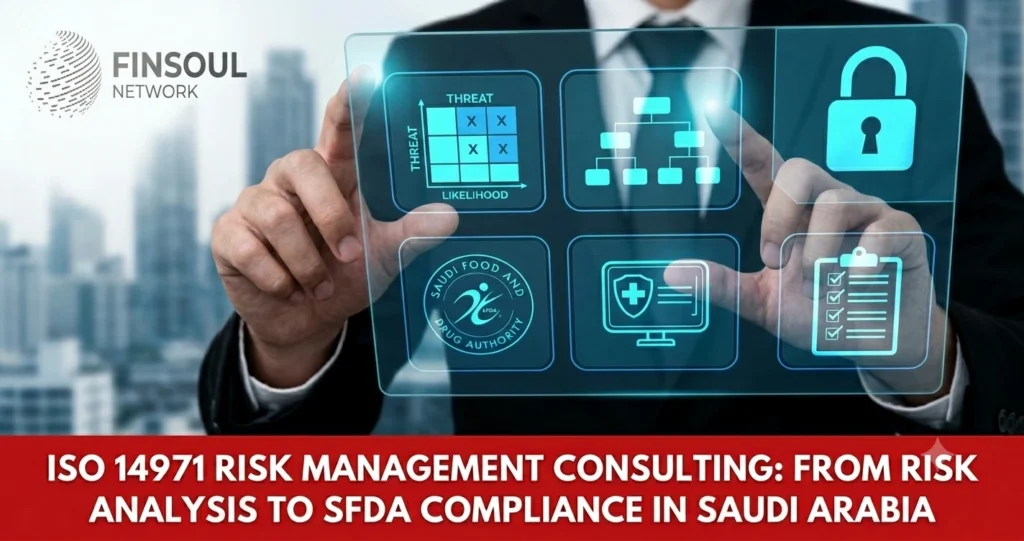
Saudi Arabia’s medical device market is expanding rapidly, and regulatory expectations are rising with it. For any manufacturer or distributor seeking SFDA registration, risk documentation is not a formality; it is a gateway. Incomplete or poorly structured risk files are among the leading causes of submission delays in the Kingdom.
ISO 14971 risk management consulting has become indispensable for organizations entering this market. SFDA requires manufacturers to demonstrate systematic, traceable risk control across the full device lifecycle; meeting that expectation demands both technical expertise and direct knowledge of local regulatory requirements. At Finsoul Network KSA, we help medical device companies build risk management files that withstand SFDA scrutiny from the first review.
Why ISO 14971 Matters for Medical Devices in Saudi Arabia
The SFDA explicitly references ISO 14971 in its technical dossier requirements. Every device registration across all risk classes must include a risk management file demonstrating that all foreseeable hazards have been identified, controlled, and evaluated against clinical benefit.
When risk management is treated as an afterthought or a generic checklist exercise, the consequences are predictable: SFDA clarification requests, additional data demands, and delays that push market entry back by months. Organizations that invest in structured ISO 14971 risk management consulting early, before design freeze, consistently move through the SFDA registration pathway with fewer obstacles.
The Growing Saudi Medical Device Market
Vision 2030 has positioned healthcare as a strategic priority for the Kingdom. With major hospital infrastructure investments, a push toward local device manufacturing, and growing domestic demand, Saudi Arabia’s market is projected to surpass USD 3.5 billion by 2030.
This growth has brought heightened regulatory scrutiny. SFDA technical reviewers examine risk files with increasing rigor as import volumes and local production scale upward. A professional, device-specific risk management file is now a baseline requirement for competitive market participation.
What SFDA Expects from ISO 14971 Risk Files
ISO 14971 SFDA compliance goes well beyond submitting a completed template. SFDA reviewers are trained to identify files that lack genuine device-specific analysis. Key expectations include:
- Full traceability Each hazard must trace through to a specific control measure and a documented residual risk evaluation
- Device-specific hazard analysis Generic hazard lists are routinely flagged; every risk must reflect the actual device under review.
- Evidence-based benefit-risk justification Residual risks above the acceptable threshold must be supported by clinical evidence
- Hierarchical risk controls Controls must cover inherent safety by design, protective measures, and information for safety where applicable.
- ISO 14971:2019 alignment SFDA expects compliance with the current edition; references to the 2007 version require justification
The ISO 14971 Risk Management Process
Effective ISO 14971 risk management consulting is built around the standard’s structured, sequential process. Each step matters; skipping any one of them is the most common reason SFDA submissions receive major queries:
- Hazard Identification All foreseeable hazards are systematically identified across energy, biological, software, usability, and environmental domains using cross-functional input
- Risk Analysis Probability and severity of each hazard are estimated using a defined and documented methodology
- Risk Evaluation Estimated risks are compared against the organization’s acceptability criteria to determine which require further control.
- Risk Control Controls are implemented at the appropriate hierarchy level and verified for effectiveness.
- Residual Risk Evaluation Remaining risks after control are assessed individually and in combination; benefit-risk justification is documented for risks above threshold.ld
- Post-Market Surveillance Integration Live field data feeds back into the risk file throughout the device’s commercial lifecycle.
Common Pitfalls in Risk Management Files
Most SFDA clarification requests related to risk management trace back to predictable gaps. Use this checklist to self-assess before submission:
- Generic hazard lists not tailored to the specific device and intended use
- Probability estimates absent or not supported by rationale
- No traceability matrix linking hazards, controls, and residual risk outcomes
- Risk controls verified with no objective evidence that the measure reduces risk
- Software and cybersecurity risks omitted for connected or software-driven devices
- Benefit-risk justification missing for residual risks above the acceptable threshold
- Post-market surveillance not referenced or linked within the risk management file
- Risk file clearly not integrated into the actual design process, written retrospectively
The Role of Post-Market Surveillance in ISO 14971
Risk management and ISO 14971 compliance does not end at registration. The standard requires risk management to continue across the device lifecycle, with post-market surveillance (PMS) acting as the primary feedback mechanism.
Complaint trends, adverse event reports, field performance data, and literature reviews must be periodically reviewed and used to update the risk file where real-world experience diverges from pre-market estimates. SFDA expects a documented, functional link between your PMS system and risk management file; organizations that maintain these as separate silos are exposed during post-market inspections.
How Early ISO 14971 Work Saves Time and Cost
One of the strongest arguments for investing in ISO 14971 risk management consulting at the design stage is the cost of late discovery. Hazards identified during design can be eliminated through inherent safety measures. The same hazards found after design freeze require compensatory controls, additional testing, and label revisions that extend timelines and budgets.
SFDA reviewers can also identify risk files built retrospectively versus those integrated into genuine development. Files that reflect actual design history carry substantially more credibility during technical review.
Choosing the Right ISO 14971 Consultant
Risk management and ISO 14971 expertise varies significantly across the consulting market. When evaluating a partner for SFDA submissions, ensure your ISO 14971 risk management consulting provider can demonstrate:
- Demonstrated SFDA submission experience specifically for ISO 14971 risk file reviews
- Device-category knowledge relevant to your product class
- Ability to integrate risk management with clinical evaluation, usability engineering, and PMS
- Support through clarification requests, not just initial file preparation
- Fluency with ISO 14971:2019 and current IMDRF guidance
- Transparent methodology that builds your team’s internal capability
At Finsoul Network KSA, our advisory team combines technical depth with direct SFDA process experience supporting manufacturers from initial gap assessment through to successful registration.
Conclusion
A robust, traceable, device-specific risk management file is one of the clearest competitive advantages a manufacturer can build in the Saudi market. As SFDA oversight intensifies and competition grows, the quality of your ISO 14971 risk management consulting work directly determines how quickly and successfully your product reaches Saudi clinicians and patients.
ISO 14971 SFDA compliance is not a hurdle to clear at the last moment; it is a discipline to embed from the earliest stages of development. Manufacturers that act on this with expert support register faster, respond to queries with confidence, and build lasting regulatory credibility in the Kingdom.
Reach out to Our team today to discuss your risk management needs and take the first step toward a stronger, faster SFDA submission.
Frequently Asked Questions
1. What is ISO 14971 and why does SFDA require it?
ISO 14971 is the international standard for applying risk management to medical devices. It provides a systematic framework for identifying, analyzing, controlling, and monitoring device-related hazards across the full product lifecycle. SFDA requires compliance with this standard as part of the technical dossier for all device registrations in Saudi Arabia. A compliant, device-specific risk file is a prerequisite, not optional documentation.
2. What does a complete ISO 14971 risk management file contain?
A complete file includes a risk management plan, hazard identification records, risk analysis outputs with probability and severity estimates, risk evaluation against acceptability criteria, documented control measures with verification evidence, residual risk evaluations, an overall benefit-risk justification, and a risk management summary report. It must also formally link to the post-market surveillance system as an ongoing data source.
3. How long does it take to prepare a risk management file for SFDA?
The timeline depends on device complexity and risk class. A Class A or B device with a straightforward risk profile may require four to eight weeks when approached properly. Complex Class C or D devices, particularly those with software, connectivity, or novel clinical applications, typically require twelve or more weeks to complete to SFDA standard.
4. Can a CE-marked risk file be submitted to SFDA as-is?
A CE-marked file provides a useful foundation, but direct submission without adaptation is inadvisable. SFDA reviewers may have specific expectations around file structure, regional use-environment considerations, and Arabic labelling risks that CE files do not address. An experienced consultant can efficiently close the gaps between CE documentation and SFDA requirements.
5. What happens if SFDA issues a clarification request on the risk file?
SFDA clarification requests on risk files typically require additional hazard analysis, updated control verification evidence, or stronger benefit-risk justification. Response windows are defined and strictly enforced. Inadequate responses trigger further queries or rejection. Engaging a consultant with direct SFDA experience to interpret and respond to clarifications is essential to protecting your registration timeline.