
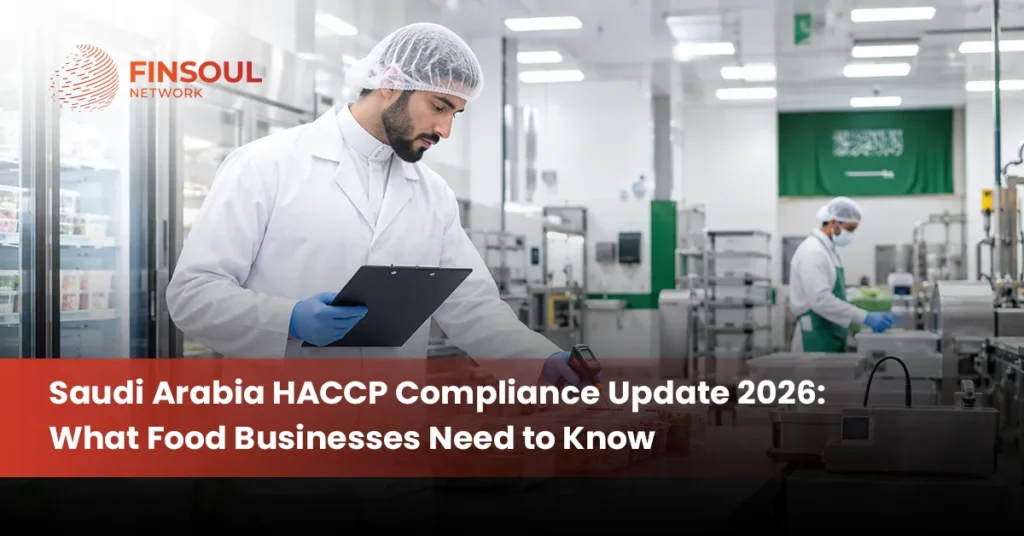
Food safety rules in the Kingdom are getting stricter, and 2026 brings some of the most significant changes yet. If you run a restaurant, catering company, food factory, or export business, staying on top of HACCP compliance Saudi Arabia is no longer optional. Finsoul Network KSA has put together this guide to walk you through exactly what’s changing, who it affects, and how to get ahead of it before deadlines hit.
What’s New: SFDA Updates for 2026
The Saudi Food and Drug Authority (SFDA) has rolled out an updated framework that ties HACCP compliance Saudi Arabia more closely to Gulf Standardization Organization (GSO) food safety benchmarks. The update focuses on three areas: stricter documentation for critical control points, mandatory digital record-keeping for larger facilities, and shorter renewal windows for existing certificates.
For businesses already working toward HACCP certification in Saudi Arabia, this means existing audit checklists need a refresh. Inspectors are now paying closer attention to how hazards are monitored day to day, not just whether a plan exists on paper.
Why This Update Matters for Food Businesses
Ignoring HACCP compliance Saudi Arabia rules isn’t just a paperwork risk anymore. The SFDA has increased on-site inspections across Riyadh, Jeddah, and Dammam, and non-compliant facilities can face fines, suspended operating licenses, or export bans. For businesses selling into GCC markets, a lapsed or outdated certificate can also mean losing contracts with retailers and distributors who now require proof of current certification before signing agreements.
On the flip side, businesses that adapt early gain a real advantage. Buyers, auditors, and even customers increasingly see a valid HACCP certificate as a baseline trust signal, not a bonus.
Impact on Food Exporters and Trade Partners
Businesses shipping products beyond the Kingdom feel this update the most. Many GCC and international buyers now ask for proof of HACCP compliance Saudi Arabia standards before finalizing a purchase order, and some distributors have started rejecting shipments that arrive with outdated documentation. Customs authorities are also cross-checking certification status more frequently at ports, which means a lapsed certificate can hold up an entire shipment, not just delay a single inspection. Exporters who keep their paperwork current tend to move goods through customs faster and build longer, more stable relationships with overseas partners.
Who Needs to Comply
The updated rules apply broadly across the food supply chain, including:
- Restaurants, cafes, and catering companies
- Food manufacturing and processing plants
- Cold storage and logistics providers handling perishable goods
- Food exporters and importers
- Hotels and large-scale hospitality kitchens
- Retailers with in-house food preparation (bakeries, delis, butcheries)
If your business falls into any of these categories, a compliance review should be on your calendar this quarter. Even businesses that operate on a small scale, such as a single kitchen or a neighborhood bakery, are not exempt from HACCP compliance Saudi Arabia obligations, though the depth of documentation expected may be lighter than what’s required of a large manufacturing plant.
Key Changes at a Glance
Here’s a quick comparison of what’s shifted between the previous framework and the 2026 update:
| Requirement | Previous Framework | 2026 Update |
| Certificate renewal cycle | Every 3 years | Every 2 years |
| Record-keeping | Paper or digital, optional | Digital logs mandatory for medium/large facilities |
| Inspection frequency | Annual | Bi-annual for high-risk categories |
| Documentation depth | General hazard plan | Detailed CCP monitoring logs required |
Steps to Achieve Compliance
Getting your facility aligned with the new rules doesn’t have to be overwhelming. A practical path usually looks like this:
- Conduct a gap assessment. Compare your current hazard plan against the updated SFDA checklist to see exactly where your documentation, monitoring, or training falls short before an inspector points it out for you.
- Update your documentation. Build out CCP monitoring logs that match the new digital record-keeping expectations, and make sure corrective action records are dated, detailed, and easy for an auditor to follow.
- Train your team. Staff handling food prep, storage, and transport need refreshed training on the revised protocols, since most compliance gaps trace back to inconsistent day-to-day practices rather than a flawed written plan.
- Pursue HACCP certification online. Many facilities now complete much of the preparation and assessment process remotely, which cuts down on downtime while your kitchen or plant stays operational, and it also makes HACCP certification in Saudi Arabia far more accessible for smaller businesses without dedicated compliance staff.
- Schedule your audit early. With inspection frequency rising, booking your HACCP food safety certification audit ahead of peak season avoids last-minute delays and gives you room to fix any issues an auditor flags before your renewal deadline arrives.
Working with a consultant who understands the local regulatory landscape makes this process considerably faster, especially if you’re pursuing HACCP certification online for the first time and want to avoid common documentation errors.
Common Compliance Mistakes to Avoid
Even experienced food businesses trip up on a few recurring issues:
- Treating the hazard plan as a one-time document instead of a living record that gets reviewed and updated as processes change
- Failing to log corrective actions when a critical limit is breached, which is one of the first things inspectors check
- Skipping refresher training after the initial certification, leaving new hires unfamiliar with monitoring procedures
- Assuming a valid certificate from a previous cycle still meets the new digital record requirements introduced this year
- Underestimating how long a full HACCP food safety certification audit takes to schedule during busy periods, especially around Ramadan and peak tourism season
- Storing temperature and monitoring logs inconsistently across different shifts or locations, which makes it difficult to demonstrate continuous compliance
Benefits of Staying Compliant
Beyond avoiding penalties, keeping up with HACCP compliance Saudi Arabia standards pays off in ways that matter to your bottom line:
- Fewer product recalls and less spoilage-related waste
- Stronger positioning when bidding for retail, hotel, or government contracts
- Smoother customs clearance for exported food products
- Better insurance terms, since many providers now factor in food safety certification status
- Increased customer trust, particularly in a market where consumers are more safety-conscious than ever
Businesses that treat HACCP certification in Saudi Arabia as an ongoing commitment, rather than a box to tick, tend to sail through inspections with far less stress. In a market where HACCP compliance Saudi Arabia standards are only tightening, that kind of consistency becomes a competitive edge rather than just a regulatory checkbox.
Final Thoughts
The 2026 update to HACCP compliance Saudi Arabia requirements is a clear signal that food safety oversight in the Kingdom is only going to get more rigorous, not less. Getting ahead of it now, rather than scrambling closer to enforcement deadlines, puts your business in a far stronger position with regulators, buyers, and customers alike. Finsoul Network KSA works with food businesses across the Kingdom to simplify this process, from gap assessments to full certification support, so you can focus on running your operation with one less thing to worry about.
Get Your HACCP Compliance Ready for 2026
Don’t wait until an inspection or renewal deadline exposes gaps in your food safety system. Get expert support to assess your current HACCP setup, update the required documentation, strengthen your food safety procedures, and prepare your team for certification. Whether you’re a restaurant, food manufacturer, caterer, or exporter, getting compliant early can help you avoid unnecessary delays, penalties, and operational disruptions.
Contact Finsoul Network KSA today to discuss your HACCP requirements and take the next step toward 2026 compliance.
Our Location
Office 201 (4th Floor), SQ Tower, GCC Road, Al Khuzamah, Eastern Province, Al Khobar, Kingdom of Saudi Arabia
Email
info@finsoulnetwork.com
Contact
+966 54 865 6146
Frequently Asked Questions
What is the deadline for the 2026 HACCP compliance update in Saudi Arabia?
The SFDA has been phasing in the update gradually, with full enforcement expected by the end of 2026, so businesses should not wait until the last quarter to start preparing their documentation and staff training.
Can I complete HACCP certification online in Saudi Arabia?
Yes, most of the documentation review, training, and initial assessment stages can be completed remotely, though some facilities may still require an on-site inspection.
How often do I need to renew my HACCP certificate now?
Under the new framework, certificates generally need renewal every two years instead of every three, though high-risk facilities may face shorter cycles.
What happens if my business fails an SFDA food safety inspection?
Outcomes range from a corrective action notice with a follow-up inspection to fines or a temporary suspension, depending on the severity of the violation.
Do small food businesses also need HACCP food safety certification?
Yes, though the documentation depth and inspection frequency are typically lighter for smaller operations compared to large-scale manufacturers.